
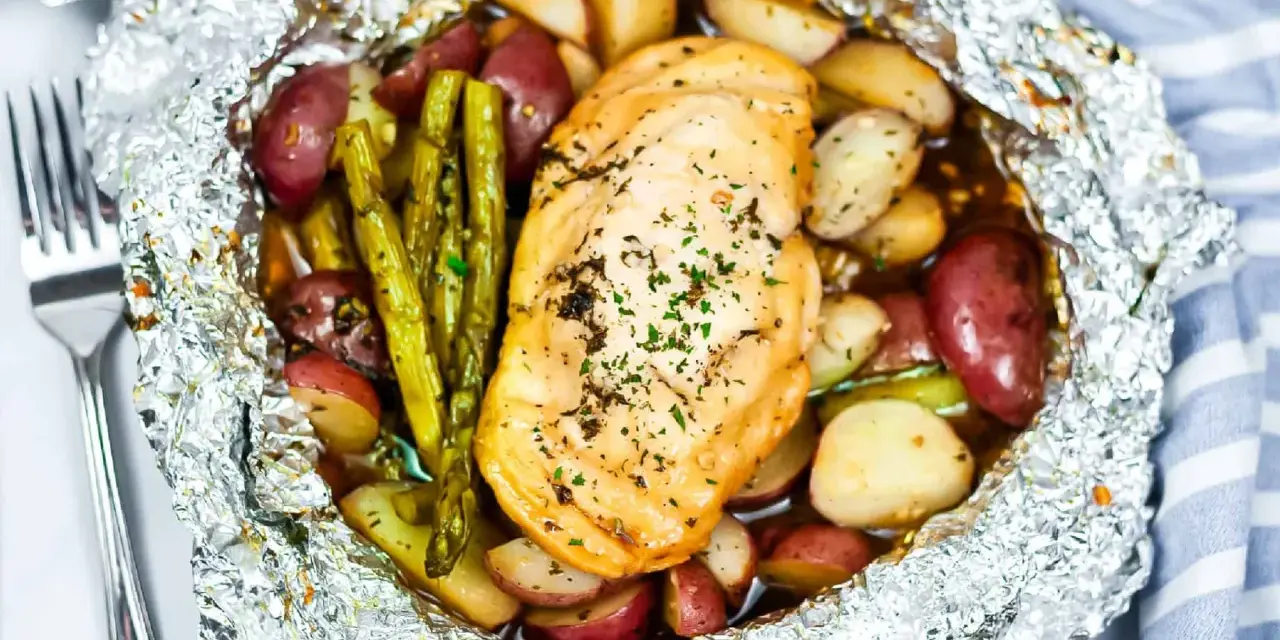
Quick facts for a reliable oven-baked packet dinner
- Use boneless chicken thighs if you want the most forgiving result; chicken breast works, but timing matters more.
- For most UK ovens, set the heat to 200°C conventional or 180°C fan.
- Cook until the chicken reaches 75°C at the centre, or follow the Food Standards Agency target of 70°C for 2 minutes.
- Cut potatoes and other firm vegetables small so they finish at the same pace as the chicken.
- Place the packets on a baking tray so they are easier to move and any leaked juices stay contained.
- Seal the foil firmly, but leave a little space inside the packet so steam can circulate.
Why the oven version works so well at home
I like this method because it gives me the same simple, camp-style result without depending on weather, firewood, or a grill that behaves differently every time. The oven gives steady heat, which is a real advantage when you are cooking chicken, because a foil packet needs enough time to steam the vegetables while the meat cooks through safely.
That said, the oven version is not just a compromise. It actually solves a few problems that campfire cooking often creates: flare-ups, uneven heat, and packets that sit too close to the embers on one side and barely warm on the other. If you want the flavour profile of a campsite supper but prefer a cleaner kitchen result, this is the version I would start with.
| Feature | Campfire version | Oven version |
|---|---|---|
| Heat control | Variable and weather-dependent | Steady and predictable |
| Clean-up | Light, but often messy to handle outdoors | Very low, especially on a tray |
| Best use | Camping trips and outdoor cooking | Weeknight dinners, rain-proof camping prep, holiday cottages |
| Timing | Depends on fire strength | Consistent once your oven is set |
That control matters most once you move on to the ingredients, because the right cut of chicken and the right size of vegetables decide whether the packet feels balanced or half-roasted, half-steamed.
The ingredients I use for a balanced packet
For four packets, I keep the ingredient list simple and practical. I want enough flavour to feel special, but not so much that the packets become heavy or watery. The real trick is to balance a juicy protein with vegetables that can tolerate the same cooking time.
| Ingredient | Amount for 4 packets | Why I use it | Easy swap |
|---|---|---|---|
| Chicken thighs, boneless and skinless | 600 g | Stay juicy and forgiving in foil | Chicken breast, cut into even pieces |
| Baby potatoes | 400 g | Give the packet a proper camp dinner feel | Sweet potatoes or parboiled new potatoes |
| Courgette | 1 medium | Adds moisture and softens well | Green beans or sliced mushrooms |
| Red pepper | 1 large | Brings sweetness and colour | Yellow pepper |
| Red onion | 1 small | Rounds out the flavour | Shallots |
| Olive oil | 2 tbsp | Keeps the ingredients from drying out | Rapeseed oil |
| Smoked paprika, garlic, thyme, salt and pepper | To taste | Gives the packet a campfire-style depth | Mixed herbs, oregano, or Cajun seasoning |
| Lemon | 1 | Sharpens the finish and lifts the whole packet | A splash of white wine or a little butter |
I prefer thighs because they are more forgiving if the potatoes need an extra few minutes. If you want to use breast, keep the chunks smaller and check the packet earlier. That choice leads directly into the assembly method, because even the best ingredients fail if the packet is built badly.

How I build the packets so they cook evenly
The shape of the packet matters almost as much as the seasoning. I want enough room for steam, but not so much open space that the ingredients dry out before they are cooked through.
- Heat the oven to 200°C conventional or 180°C fan.
- Cut four large pieces of heavy-duty foil, roughly 35 x 45 cm each. If the foil is thin, use two layers.
- Slice the potatoes into small, even pieces, about 1.5 cm wide. Anything much bigger usually lags behind the chicken.
- Mix the chicken with the oil, seasoning, garlic, and lemon zest or juice.
- Divide the potatoes and vegetables between the foil sheets, then add the chicken on top or slightly tucked into the middle.
- Seal each packet firmly, leaving a little air space inside, and place them seam-side up on a baking tray.
I do not overpack the foil. That is one of the most common mistakes. A packet that is too full steams unevenly and tends to leave the chicken done before the potatoes are ready. A tight but not cramped parcel is the sweet spot, and once you have that in place, timing becomes much easier to manage.
Oven time, temperature and doneness
For a normal family dinner, I usually work with a cooking window rather than a single fixed minute count. Chicken pieces vary, ovens vary, and the packet size you build changes everything. The Food Standards Agency advises cooking poultry safely to a core temperature of 70°C for 2 minutes, though I usually aim for 75°C in the thickest point because it is a simple, practical target for home cooking.
| Chicken cut | Packet contents | Typical oven time | What to check |
|---|---|---|---|
| Boneless thighs | Small potatoes and mixed vegetables | 25 to 30 minutes | Chicken at 75°C and potatoes tender |
| Chicken breast | Finely chopped vegetables | 20 to 25 minutes | Chicken just cooked through, still juicy |
| Mixed thighs and potatoes | Heavier, more rustic packet | 30 to 35 minutes | Fork-tender potatoes and clear juices |
If I want a little more colour, I open the packets carefully for the final 2 to 3 minutes and give them a brief blast under a hot grill. I only do that once the chicken is already cooked, because the grill is for finishing, not for rescuing undercooked food. For safety, I let the packets rest for 3 to 5 minutes before serving so the heat settles and the juices stay in the meat.
Camp-friendly flavour variations and sides
Once the basic method works, it is easy to steer the flavour in different directions without losing the camp-style character. I keep every variation straightforward, because foil packet food becomes muddy fast when you add too many sauces or wet ingredients.
- Mediterranean style - Use oregano, lemon, courgette, cherry tomatoes, and a few olives. This one feels bright and holiday-ready.
- Smoky BBQ style - Swap the paprika for BBQ seasoning, then add sweetcorn and red onion. It tastes closest to a classic family campsite supper.
- Lemon herb style - Use thyme, parsley, butter, and thinly sliced new potatoes. I reach for this when I want something lighter but still satisfying.
- Warm spice style - Add cumin, coriander, and a little chilli flakes with peppers and onions. It is useful when you want more depth without much extra work.
For sides, I keep things simple: a green salad, crusty bread, couscous, or buttered peas. If I am cooking for a holiday cottage dinner, I might add a bowl of yoghurt with chopped herbs and lemon to cool the seasoning down a little. That same flexibility is what makes foil packets so practical, but only if you avoid the mistakes that tend to flatten the result.
The mistakes that make foil packets disappointing
I see the same few issues again and again, and they are all easy to avoid once you know what to watch for.
- Cutting the potatoes too large - They stay firm long after the chicken is ready.
- Using too much sauce - The packet turns watery instead of juicy.
- Sealing the foil too loosely - Steam escapes, and the vegetables dry out.
- Overfilling the packet - Heat moves slowly through the centre and the cooking time becomes unreliable.
- Skipping the baking tray - The packets are harder to move and any leak becomes a problem.
- Opening too early - Heat loss adds time and can leave the vegetables half-done.
My own rule is simple: if the packet looks crowded before it goes into the oven, it will probably cook crowded too. Once that is under control, the recipe becomes ideal for planning ahead, which is where it starts to feel especially useful for family travel and relaxed evenings.
Make-ahead, leftovers and the kind of dinner I return to
I often assemble the packets earlier in the day, then keep them chilled until I am ready to bake. If you do that, make sure the chicken stays cold and the potatoes are cut evenly so they do not brown awkwardly before cooking. For leftovers, I follow the Food Standards Agency advice and keep them chilled, then eat them within 48 hours. Reheat until piping hot rather than serving them lukewarm.
This dish also scales well. One packet is enough for a light lunch; four packets feed a family without turning the kitchen into a production line. If I know the next day will be busy, I will sometimes make an extra packet on purpose, because the reheated version still works well in a lunchbox, stuffed into a wrap, or served with salad.
The main advantage is not just convenience. It is the way this method keeps dinner relaxed without making it feel plain. That balance is what I want from camp cooking at home, and it is exactly why this version stays in my rotation whenever I want something easy, rustic, and dependable.
The small choices that keep it tasting like campfire food
The oven will not give you smoke, but it can still give you the same honest, one-packet simplicity I want from a campsite meal. If you choose a forgiving cut of chicken, chop the vegetables to the right size, season boldly, and cook to temperature instead of chasing a fixed minute count, the result feels properly camp-inspired without any fuss.
That is the version I would keep in a family camping notebook: adaptable, low-mess, and easy to repeat on a rainy evening in the UK or on a laid-back holiday night when everyone wants dinner fast. The technique is simple, but the difference between average and really good foil packets comes down to those small, practical choices.
