
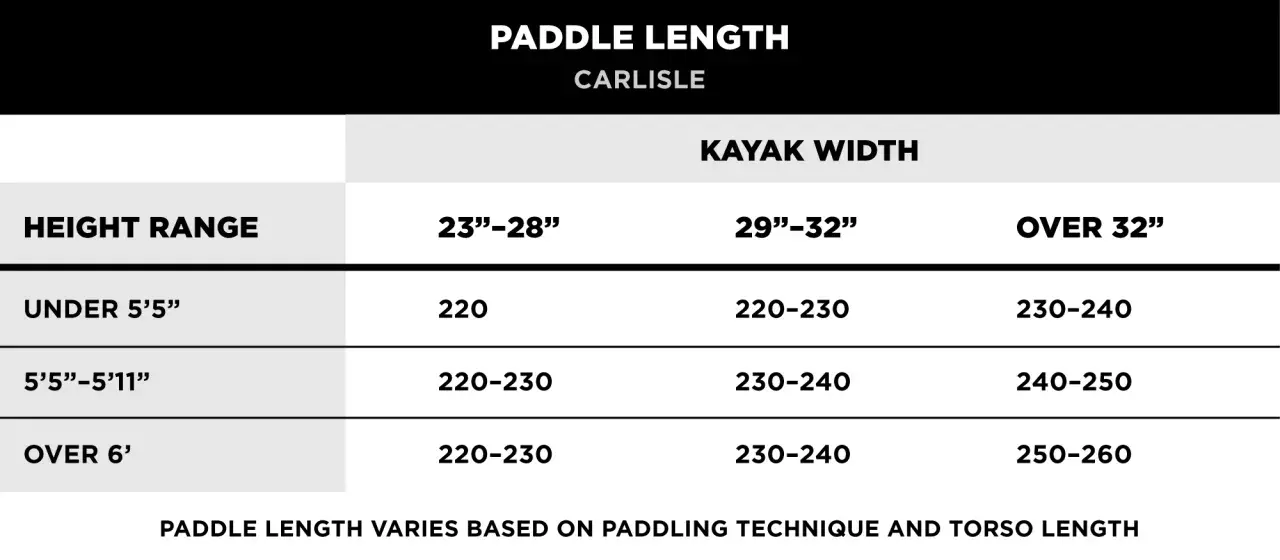
A good kayak paddle size chart saves time and prevents an expensive mistake: buying a blade that feels wrong after the first few strokes. The right length depends on boat width, paddler height, and the angle of your stroke, so one number rarely works for every kayak. In this guide, I will show you how I size paddles, which lengths make sense for common UK boats, and how to check the fit before you commit.
The right paddle length comes from your kayak, your stroke, and how high you sit
- Start with kayak width and your height, then adjust for low-angle or high-angle paddling.
- Narrow sea kayaks usually sit around 200-215 cm; standard touring kayaks often land around 215-230 cm.
- Wider recreational and sit-on-top kayaks often need 230-250 cm to keep the stroke clean.
- If you are between sizes, I usually lean shorter for a more active stroke and longer for a relaxed touring style.
- Adjustable paddles are useful when one paddle has to work for different boats, seats, or family members.
How to read a kayak paddle size chart without overthinking it
REI's sizing guide treats boat width and paddler height as the two main variables, and that is where I start as well. The logic is simple: a wider hull needs more shaft to clear the deck, while a taller paddler usually needs more reach. Then the stroke changes the answer again. A low-angle touring stroke keeps the shaft more horizontal and usually suits a longer paddle, while a high-angle stroke is more vertical and usually feels better with a shorter one.
- Boat width changes how far the blade has to travel past the hull.
- Your height matters more on narrow boats, where torso length affects reach.
- Stroke angle decides whether you need extra length or a more compact shaft.
- Seat height can nudge the answer upward if you sit high above the water.
- Hull shape matters too: flare tends to favour more length, while tumblehome can let you go shorter.
That is why I treat the chart as a starting point, not a final verdict. Once you understand that rule, the next step is matching it to the kayak you actually paddle.

A practical length chart for common kayak types
On narrow sea kayaks, a UK sea-kayak guide from Sea Kayak Paddler UK places higher-angle paddles around 200-214 cm for intermediate paddlers in 16-17 ft boats. That lines up with the ranges I would expect for most adult paddlers in typical touring conditions.
| Kayak type | Typical width | Good starting length | Why it usually fits |
|---|---|---|---|
| Narrow sea kayak or performance touring | Under 23 in / 58 cm | 200-215 cm | Keeps the blade close to the hull and suits a quicker stroke. |
| Standard touring kayak | 23-28 in / 58-71 cm | 215-230 cm | A common sweet spot for day touring and mixed UK paddling. |
| Recreational kayak | 28-32 in / 71-81 cm | 230-240 cm | Helps clear a wider beam and often a higher seating position. |
| Wide sit-on-top or fishing kayak | Over 32 in / over 81 cm | 240-250 cm | Gives extra reach over a broad deck and higher seat. |
| Whitewater kayak | Width matters less | 191-203 cm | Shorter shafts suit quick cadence and a more vertical stroke. |
As a rule, I move toward the shorter end if the paddle will be used with a quicker, more athletic stroke, and toward the longer end if the stroke is relaxed and low-angle. The next question is when you should step outside these starting ranges.
When to go shorter or longer than the chart
This is where people often buy the wrong size by a single step. The chart gets you close, but the details can push you one way or the other.
- Go shorter if you paddle high-angle, sit low in the cockpit, or use a narrow touring or sea kayak.
- Go longer if you paddle low-angle, sit high above the water, or use a wide recreational or sit-on-top kayak.
- Go longer if you have a long torso, even when your overall height is average.
- Go shorter if your torso is compact and you dislike reaching above shoulder level.
- Go longer for flare, flat bottoms, or V-shaped hulls, because they make the paddle work a little farther from the boat.
- Go shorter for tumblehome hulls, which narrow toward the cockpit and let the blade track closer in.
- Use the longer end if two paddlers need one paddle for different boats or seat positions.
If you are stuck between two lengths, I usually favour the shorter paddle for an active stroke and the longer one only when comfort and low-angle cruising matter more than speed. Once those adjustments make sense, blade shape and shaft construction decide how the paddle feels in your hands.
Blade shape, shaft material and adjustability
Length is only half the story. Blade shape changes the rhythm of the stroke, and the shaft material changes how heavy the paddle feels after an hour on the water. A high-angle paddle usually has a shorter, wider blade because it wants a quicker catch and a more powerful pull. A low-angle blade is usually longer and narrower, which feels calmer and is easier to live with on long, steady outings.
- Aluminium shafts are the cheapest, but they are also the heaviest.
- Fibreglass and other composites sit in the middle: lighter, stiffer, and usually more comfortable over distance.
- Carbon shafts are the lightest and stiffest, which is great if shoulder fatigue matters and the budget allows it.
- Feather angle is the offset between the two blades; it can help with wrist comfort and wind resistance, but it will not fix the wrong length.
- Adjustable paddles are worth considering if you share boats, rent often, or want one paddle that can cover a narrow touring kayak and a wider family boat.
For family trips and mixed holiday use, I think adjustability is often the most practical compromise, because it buys flexibility without forcing you to own three separate paddles. Before you spend the money, though, I always check the fit on the water rather than trusting the label alone.
The on-water fit test I trust before buying
The real test is what happens after ten minutes of paddling, not how the number looks in a shop. I want a paddle that lets me keep my normal posture, keep the blades entering cleanly, and avoid the feeling that I am reaching for the water.
- Sit in the kayak with the same seat height, backband, and foot position you will use on the water.
- Take a few strokes at your normal pace and watch your top hand.
- For low-angle touring, the top hand should stay below shoulder level; for high-angle paddling, it can rise higher, but it should not force you to shrug.
- Check that the blade catches cleanly without you twisting the torso too far or leaning forward to compensate.
- After a short spell, your shoulders should feel engaged, not crowded, and your neck should stay relaxed.
- Too long often feels splashy, slow, and awkward at the catch.
- Too short usually forces more hunching and gives you less leverage over the water.
- Close but not perfect is often solved by 5 cm, not 20 cm.
If you can test two adjacent sizes on the same boat, do it; the difference is usually obvious once you are actually paddling.
My shortest practical answer for most UK paddlers
If you want the quickest starting point, I would use this:
- 200-215 cm for narrow sea kayaks, performance touring boats, and faster high-angle strokes.
- 215-230 cm for most touring kayaks used on lakes, rivers, canals, and coastal day trips.
- 230-250 cm for wider recreational kayaks and sit-on-top boats.
- 191-203 cm for whitewater kayaks, where quick cadence matters more than reach.
That range is not about chasing a perfect textbook answer; it is about landing close enough that the paddle disappears into the movement of the boat. If you remember one thing, remember this: the right size is the one that lets you paddle without shrugging, overreaching, or fighting the kayak, and I would always test two neighbouring lengths before I bought the final one.
