
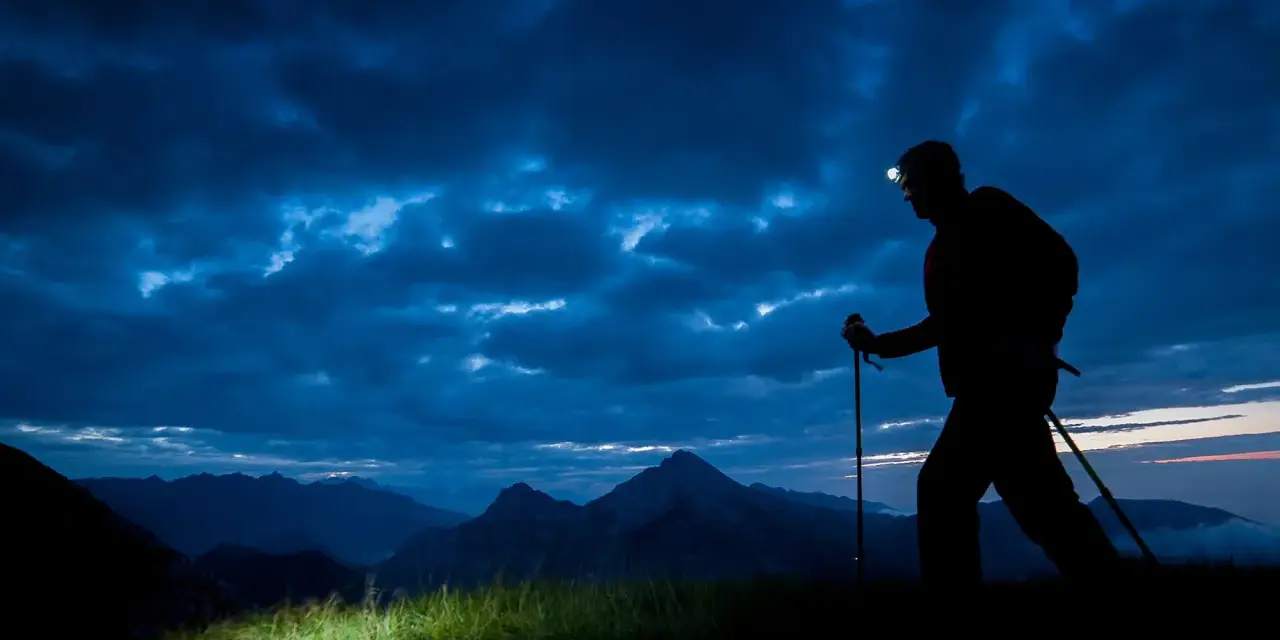
A night hike feels different from a daytime walk in almost every respect: landmarks flatten out, pace slows, and simple decisions matter more. This guide breaks down how to choose a sensible route, what kit actually earns its place in your pack, and how to stay comfortable and oriented once the light disappears.
The safest approach is simple route choice, redundant light, and honest timing
- Start on a familiar loop or a route with obvious handrails, not a complex ridge or boggy open ground.
- Carry a headtorch, a backup light, a paper map, a compass, and a charged phone, but do not rely on the phone as your main navigation tool.
- Tell someone where you are going, when you expect to be back, and when you will turn around if the walk is running late.
- Dress for colder and wetter conditions than the forecast suggests, especially in the UK where weather can change fast.
- For family outings, keep the route short, clear, and interesting rather than trying to make it feel adventurous by adding risk.
What changes once the sun goes down
The biggest difference is not just visibility. Darkness changes depth perception, makes junctions harder to recognise, and turns a route you know well into something that demands more attention. A stile, a muddy patch, or a missed path can matter much more when your light only reaches a few metres ahead.
I also find that pace naturally drops after dark. That is not a weakness; it is a sensible response to reduced information. You are making decisions with less context, so the walk should be planned to allow for slower movement, more stops, and more deliberate navigation.
| Part of the walk | In daylight | After dark |
|---|---|---|
| Navigation | Landmarks are easy to spot and compare | You need a tighter rhythm of map checks and time checks |
| Terrain reading | Slopes, puddles, and path edges are obvious | Shadows hide texture, so footing deserves more attention |
| Route choice | You can accept more variety and detours | Simple loops and clear handrails work better |
| Comfort | Temperature changes feel less urgent | Cold, wind, and dampness become more noticeable quickly |
Once you understand those differences, the next question is obvious: which routes are worth doing after dark, and which ones are better left for daylight?

Choose a route that stays simple after dark
For a first outing, I would look for a route with strong visual boundaries: a forest track, a riverside path, a park loop, or a well-marked coastal promenade away from cliffs. These routes are forgiving because they reduce the number of moments where you need to guess what comes next.
In the UK, I would be cautious with open moorland, complex fell routes, tidal sections, and exposed ridge paths unless you already know the ground well and the weather is stable. Darkness is one thing; darkness plus poor ground, wind, and mist is where mistakes pile up.
| Route type | Why it works | When I would skip it |
|---|---|---|
| Woodland loop | Clear edges, shelter from wind, and usually simple navigation | After heavy rain if the path becomes slippery or flooded |
| Riverside or canal path | Easy to follow and good for mixed-ability groups | If there are frequent road crossings or poor lighting sections |
| Coastal promenade | Strong linear features and a very obvious direction of travel | Near cliffs, tide gaps, or unlit stretches with fast weather exposure |
| Open hill or moor | Can be rewarding for experienced navigators | For a first dark walk, or whenever mist, wind, or wet ground is in play |
The kit I would never leave behind
I treat lighting and navigation as non-negotiables. Ramblers suggests carrying a spare headtorch rather than loose batteries because it is easier to swap lights in the dark, and that logic is hard to argue with. I would extend that idea one step further and make sure every item in the pack still works when visibility drops and your hands are cold.
| Item | Why it matters | My practical note |
|---|---|---|
| Headtorch | Keeps your hands free and gives directed light where you need it | Choose a beam that lets you see the path without bleaching out your night vision |
| Backup light | Protects you if the main torch fails | I prefer a second torch in the pack rather than loose batteries |
| Paper map | Still works when the battery dies or the signal drops | Keep it in a waterproof case or map sleeve |
| Compass | Lets you confirm direction without guessing | Useful even on familiar routes when landmarks disappear |
| Phone and power bank | Useful as a backup for emergencies and route checks | Keep it charged, dry, and treated as support rather than the main plan |
| Warm layer and waterproof shell | Darkness often arrives with cooler, damper conditions | A spare insulating layer can matter more than an extra snack |
| Whistle | Helps you signal if you need attention | Small, light, and easy to justify |
| Water and snacks | Fatigue makes navigation worse | A small, easy-to-eat snack is often enough for short evening walks |
I also like a bit of reflective detail on my outer layer or backpack if the route brushes any roads. It is not a substitute for light, but it makes you easier to spot when a car, cyclist, or another walker appears unexpectedly.
How I navigate without losing pace
Night navigation works best when it becomes a repeatable routine. I start by checking the map in daylight, identifying the key turns, and marking the obvious handrails, such as fences, walls, streams, or tree lines. Then I decide where I will check time, not just distance, because darkness makes time drift feel more expensive.
On the walk itself, I keep the beam low unless I need to inspect rough ground. A bright light can flatten the landscape and make everything beyond the beam disappear. A lower setting often preserves more natural depth perception, which makes the path easier to read.
- Set the route before you leave, including a turn-back time.
- Identify two or three decision points on the map before the first step.
- Walk in shorter sections, then stop and confirm position at each junction or feature change.
- Use the torch for the ground in front of you, but use the map and compass for direction.
- If you miss one landmark, stop early. If you miss two, reorient instead of pushing on.
I have found that most problems start when people try to save time by skipping those small checks. The route is often fine. The discipline is what slips first. Once that is clear, the remaining risks are mostly weather and terrain, especially in the UK.
Weather, terrain, and UK conditions that change the game
The UK rewards caution because the weather can make a simple route feel much harder very quickly. Rain turns easy ground into slippery ground, wind strips away warmth faster than people expect, and fog removes visual clues that were doing half the work for you a minute earlier.
| Condition | Why it matters at night | What I do |
|---|---|---|
| Fog | It shortens your visible range and removes depth cues | Stick to obvious lines and avoid committing to unfamiliar ground |
| Heavy rain | Footing worsens and small streams can become less obvious to cross safely | Choose surfaced or well-drained paths instead of rough ground |
| Wind | It increases chill and can make exposed paths unpleasant or risky | Prefer sheltered routes and carry an extra layer |
| Frozen or muddy ground | Slips become more likely when you cannot see the texture clearly | Slow down and avoid steep sections if footing is uncertain |
| Coastal tides | Darkness can hide tide lines and access points | Only use coastal routes if timing and exits are clear in advance |
If I am heading into the hills, I also check a forecast that reflects the terrain rather than just the nearest town. That distinction matters because a valley forecast can look acceptable while exposed ground is still windy, wet, and cold enough to change the entire character of the walk.
These conditions also explain why a backpacking trip needs even tighter timing. If you are pitching camp after a long day, I would build in enough daylight to sort water, food, and shelter before darkness becomes the default working condition.
Making it enjoyable for children and mixed-ability groups
A dark walk does not have to feel serious to be worthwhile. For family adventures, I prefer a short loop with a clear start and finish, a route that can be explained in plain language, and one or two small moments that create atmosphere without adding risk. A woodland path near a campsite, a farm track with good boundaries, or a simple park circuit can be more memorable than a harder route because everyone stays relaxed.
Each person should have their own light if possible. Shared torches cause delays, arguments over brightness, and too much stopping. For children, I would keep the walk playful but structured: listen for owls, notice reflected eyes in the torch beam, or pause to compare how sound changes when the route moves from open ground into trees.
My personal limit for a first family evening outing is usually modest. I would rather finish wanting a little more than be forced to improvise because someone is cold, bored, or tired. That approach keeps the memory good, which is exactly what outdoor trips are supposed to do.
The mistakes that make dark walking harder than it needs to be
Most failures on evening walks are predictable, and that is useful because predictable mistakes are easy to avoid. I see the same few issues come up repeatedly, especially with people who know the daytime route well and assume that familiarity will cover the rest.
- Relying on a phone torch instead of a proper headtorch.
- Starting later than planned and hoping the walk will somehow speed up.
- Choosing a route that is only sensible in daylight.
- Forgetting that cold and wet conditions drain energy faster.
- Not setting a turn-back point before setting off.
- Carrying kit you have never used, rather than the kit you know you can operate quickly.
The deepest mistake is psychological: people often think darkness is the main problem when, in practice, poor planning is the main problem. If the route is simple, the torch is reliable, and the timing is honest, the experience is usually calm rather than dramatic.
My final checks before I set off
- I know the route and can explain it without opening the map every minute.
- I have a headtorch, a backup light, and enough battery life for the return.
- My map, compass, phone, and any spare layer are packed where I can reach them quickly.
- Someone knows where I am going and when I expect to be back.
- I have a clear turn-back time, even if the route is going well.
- The weather, tide, or ground conditions still make sense for the route I chose.
If those boxes are ticked, I go. If they are not, I simplify the plan, shorten the distance, or leave the walk for another evening. That is usually the difference between a memorable outing and an avoidable problem.
