
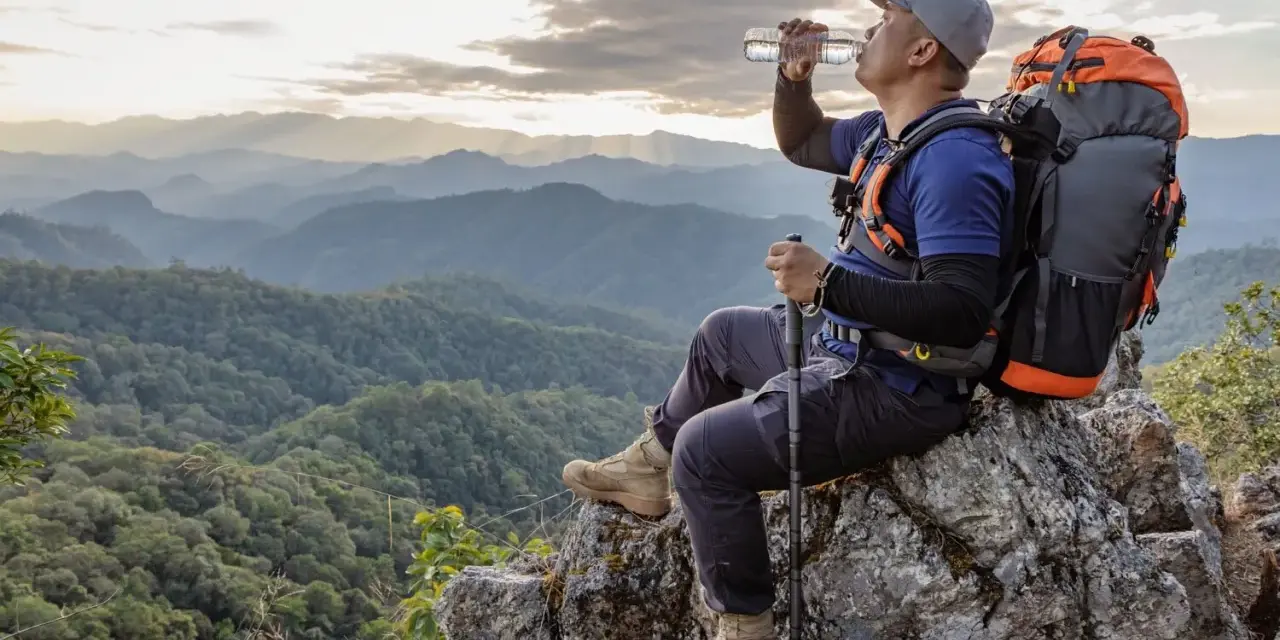
The honest answer to how much water to take backpacking is that there is no single number that works on every trail. I plan for the next safe refill, then add a small margin for heat, pace, and the occasional mistake, because that is what actually keeps a trip comfortable and safe. For most backpacking days in the UK, that means thinking in litres per stretch rather than litres per day.
The practical answer at a glance
- Start with 0.5 litres per hour in cool to moderate conditions, then adjust upward if the day gets hotter or steeper.
- In warm weather or hard climbing, plan closer to 0.75-1 litre per hour because sweat loss rises fast.
- For many UK routes, 1.5-2.5 litres covers a normal stretch, while dry or exposed sections often need 3-4 litres.
- Carry more if the next water source is uncertain, then reduce once you can refill reliably.
- Use a filter or treatment method if you plan to refill from streams, burns, or reservoirs.
Start with the next stretch, not the whole day
When I plan water for a backpacking trip, I start with the distance between reliable sources, not the total mileage. In cool conditions, about 0.5 litres per hour is a sensible baseline; on a four-hour dry stretch, that gives you roughly 2 litres before I even add a buffer. I usually add a little extra because delays happen, pace changes, and a route that looked easy on paper can feel slower in the field.
| Situation | Good starting carry | Why it works |
|---|---|---|
| Cool weather, easy terrain, short gap to water | 1-1.5 litres | Enough for comfort without hauling unnecessary weight |
| Typical UK hill day with a few hours between refill points | 1.5-2.5 litres | Covers the next stretch plus a small margin |
| Warm, sunny, or steep ascent | 2.5-3.5 litres | Sweat loss and breathing rate both rise |
| Dry ridge, moor, or uncertain water access | 3.5-5 litres | Lets you bridge a genuinely waterless section |
That range makes more sense once you remember that every extra litre adds about 1 kilogram to your pack. I would rather carry the right amount than drag 5 litres uphill just because it feels safer on paper. That balance depends heavily on conditions, which is where the real planning starts.

What changes the amount you need on trail
Heat and sun
Hot weather is the obvious multiplier, but direct sun can be just as punishing on an exposed ridge. In those conditions, I move from a moderate baseline to 0.75-1 litre per hour much faster than people expect. Wind can dry you out as well, even when the air feels cool, because sweat evaporates before you notice how much you are losing.
Climbs and pack weight
Steeper climbs raise your breathing rate, heart rate, and sweat rate all at once. Add a loaded pack and the effort climbs again, which is why a route that looks easy at sea level can demand more water than a longer but flatter walk. If I know a big ascent is coming, I carry a bit more up front so I am not forced to ration later.
Your own sweat rate
No two hikers burn through water at exactly the same rate. Body size, fitness, clothing, and how hard you push all matter, and the best way to learn your own pattern is to test it on familiar terrain. A simple method is to weigh yourself before and after a known hike, including what you drank; roughly 1 kilogram of body weight lost equals about 1 litre of fluid deficit, which gives you a practical estimate of your sweat rate.
Food and camp needs
Water is not only for walking. If you are carrying dehydrated meals, making tea, or cooking at camp, you need to budget for that too. I often add another 0.5-1 litre for the evening if I know I will need water for dinner, hot drinks, or a dry breakfast the next morning.
Once you understand these variables, the UK-specific part of the plan becomes much easier to handle, because the landscape decides how often you can realistically refill.
Plan differently for UK hills, ridges, and dry crossings
In the UK, you often have access to water sources that are simply not available in drier mountain regions, but that does not mean every source is reliable. Chalk downs, moorland, long ridges, and summer crossings can all leave you much drier than you expected. I treat every route as a question of where the next trustworthy refill is, not whether there is a stream somewhere on the map.
| Route type | What I usually plan | Why |
|---|---|---|
| Lowland walk with taps, cafés, or villages | 1-2 litres | Refills are close enough that carrying more is usually unnecessary |
| Hill day with a stream or burn on the route | 1.5-2.5 litres plus treatment | Good balance between comfort and flexibility |
| Exposed ridge, moor, or chalk section | 2.5-3.5 litres | Sources can be sparse or seasonal |
| Long dry crossing or uncertain source | 3.5-5 litres | You need enough to avoid gambling on a dry patch |
For family trips or mixed-ability groups, I am even more conservative, because pace is slower and stops are less predictable. I also check whether a source is actually usable, not just present on the map. A stream that looked fine in spring may be thin, stagnant, or contaminated later in the season, which is why route planning and water treatment should always be part of the same decision.
That leads straight into the kit side of the problem, because the right container or filter can save you from carrying far more than you need.
Carry, refill, and treat water the practical way
I rarely rely on one giant bottle unless the route is very simple. A better setup for most backpackers is a mix of containers that lets you sip while walking, measure what is left, and refill quickly at camp or a safe source. The best system is the one you will actually use consistently when you are tired.
Bottles versus bladders
Bottles are easy to monitor, share, and clean. Hydration bladders are better if you like frequent sipping on the move, but they are harder to empty and harder to judge by eye. I often prefer a simple bottle for tracking volume and a bladder only when I know I will be moving steadily for hours.
Filters and treatment
If I expect to refill from streams, burns, or reservoirs, I carry a filter or treatment tablets. A filter gives you more freedom to carry less between sources, but it does not replace planning; it just makes refills possible. Tablets are lighter and useful as a backup, while boiling works well at camp but is less practical for a moving day because it costs time and fuel.
Read Also: First Backpacking Trip UK - Plan Your Perfect Adventure
Electrolytes
Electrolytes are the salts that help your body hold and use fluid. On hot days or when I am sweating hard, I sometimes add them because they make drinking easier and can help replace sodium lost in sweat, but they do not reduce the total amount of water you need in any meaningful way. They are a support tool, not a substitute for carrying enough water.
The kit matters, but the biggest errors are usually planning errors, which is why I pay close attention to the habits that trip people up.
The mistakes that cause problems fastest
I see the same hydration mistakes repeat on backpacking trips, and most of them are avoidable with a little discipline. The worst part is that they often start small and only become obvious when the weather turns or the route runs slower than expected.
- Starting underfilled because you expect to “find water later.”
- Waiting for thirst instead of drinking steadily. The NHS uses pale yellow urine as a simple sign that you are generally well hydrated.
- Assuming a source will be there because it appears on the map, even though summer flow can be unreliable.
- Overpacking by habit and carrying more litres than the route really needs.
- Forgetting camp water for cooking, hot drinks, and the next morning’s start.
- Ignoring slower walkers or children in the group, whose hydration needs can be harder to judge on the fly.
Once those mistakes are out of the way, water planning stops feeling complicated and starts feeling routine, which is exactly where it should be before a long day outdoors.
The water plan I’d use on a real backpacking day
For a normal UK backpacking day, I would usually start with 2 litres if I know I can refill later, 3 litres if the route is exposed or the next source is uncertain, and 4 litres only when I am crossing a genuinely dry section. That keeps the pack manageable while still giving me enough margin for heat, delays, or a slower pace than expected.
If the route relies on natural water, I bring a filter or treatment tablets and treat the refill as part of the trip plan, not an optional extra. If I am walking with family or less experienced hikers, I shorten the gaps between water points and give everyone a little more than they think they need, because small delays stack up quickly when the group stops often.
The simplest rule I trust is this: carry enough for the next safe stretch, add a buffer for weather and mistakes, and use refills to avoid hauling water you do not need. That approach is usually better than either underpacking or dragging 5 litres uphill just because it feels reassuring.
