
A good hiking day is rarely improvised. This guide shows how to prepare for a hiking trip without overpacking, underestimating the route, or getting caught out by British weather. I focus on the checks that matter most in the UK: route choice, forecast, clothing, food, navigation, and the safety habits that keep a walk enjoyable rather than stressful.
The essentials that matter most before you leave
- Start with the route first: distance, elevation, surface, daylight, and escape points decide everything else.
- Check a hill or mountain forecast on the day, because town weather and upland weather are often different.
- For a day hike, a 20-30 litre pack is usually enough; backpacking needs more room for sleep and shelter kit.
- Wear broken-in footwear and a layered clothing system, especially waterproofs that you can put on quickly.
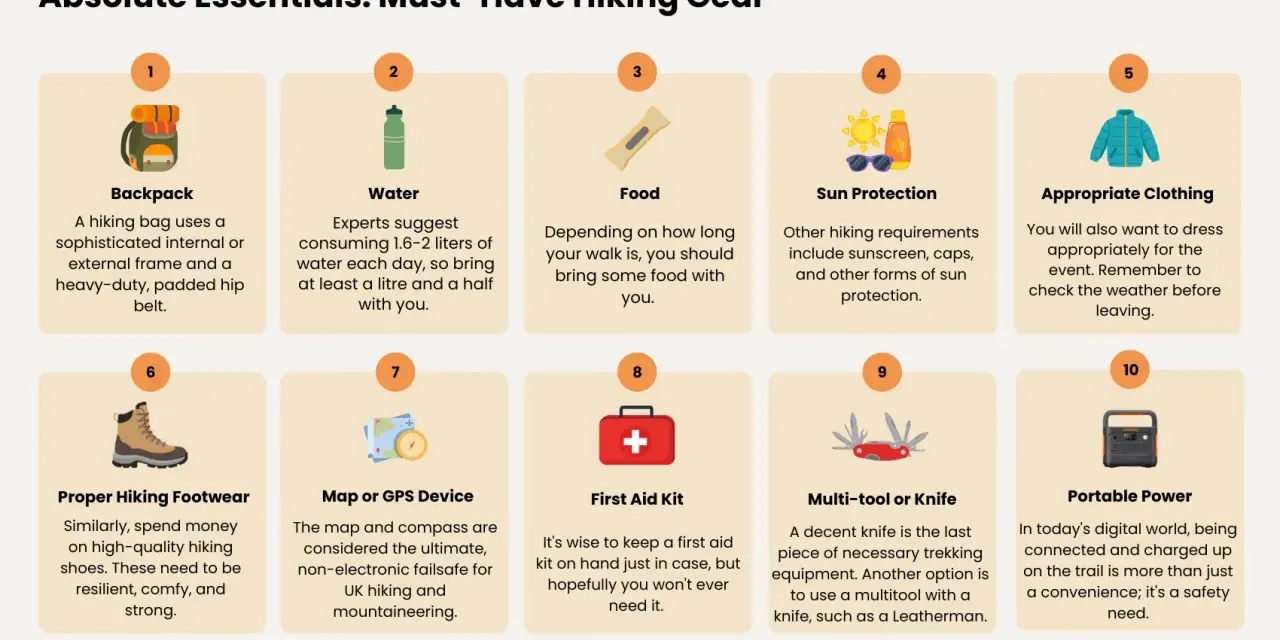
- Carry a paper map, compass, phone, power bank, headtorch, water, food, and a small first aid kit.
- Tell someone where you are going and when you expect to be back, then keep a fixed turn-back time.
Start with the route, not the backpack
I always begin by asking what the route actually demands. A flat 10-kilometre riverside walk and a 10-kilometre hill circuit with 500 metres of ascent are not the same outing, even if the distance looks similar on paper. Before I pack anything, I check the total distance, elevation gain, terrain, likely footing, parking or transport options, and whether there are sensible exit points if the day goes wrong.
For family walks, I prefer shorter loops with clear landmarks and an easy way to shorten the day if needed. For backpacking, I look at where water is available, whether camping is allowed, and how much ground can realistically be covered once the pack weight is on my back. A route that feels easy in training can become a grind once you add hills, mud, wind, and a full pack.
I also think about daylight before I think about snacks. In the UK, that matters more than people admit, especially in shoulder seasons when a route that looks comfortable on the map can turn awkward if you start late. Once the route is realistic, the next thing I check is the forecast, because weather can change the whole shape of the day.
Read the forecast as part of the plan
The forecast is not a final check for me; it is part of the route plan. A town forecast can look mild while the tops are cold, windy, and wet, so I look at conditions for the area I’ll actually be walking in, not just the nearest town. The Met Office mountain forecast is the one I trust most for hill days, because it gives a better picture of wind, rain, visibility, and temperature swings on higher ground.
My rule is simple: if the forecast makes the route feel borderline, I lower the ambition rather than hoping for the best. Heavy rain, strong wind, poor visibility, thunderstorms, or hard frost all make navigation and pacing more difficult. That does not always mean cancelling, but it does mean being willing to switch to a lower route, a shorter loop, or an entirely different day.
I also set a turn-back time before I leave. That is one of the small habits that makes a walk feel controlled instead of improvised. If I am slower than expected, the route feels more exposed than I wanted, or the weather changes in a way I dislike, I want a decision point already in place. After that, the practical question becomes what actually needs to go into the pack.
Pack the right kit for day hikes and backpacking trips
This is where people usually overcomplicate things. Most hiking kit falls into a simple pattern: protect yourself from weather, keep your feet comfortable, carry navigation backup, and bring enough food and water to stay sharp. For a day hike, a 20-30 litre pack usually covers the basics. For an overnight backpacking trip, I move up to 40-60 litres depending on the season, shelter, and sleep system.
| Item | Day hike | Backpacking trip |
|---|---|---|
| Footwear | Broken-in trail shoes or boots with good grip | Same, plus spare socks and more attention to blister prevention |
| Clothing | Base layer, insulating mid layer, waterproof shell | Add a dry sleep layer and warmer insulation for evenings |
| Navigation | Paper map, compass, phone with offline map | Same, plus a power bank and route notes |
| Safety | Headtorch, first aid kit, whistle | Same, plus an emergency bivvy or shelter layer if the route is remote |
| Food and water | Lunch, snacks, and enough water for the day | Meals, extra snacks, stove, fuel, and a plan for refills |
| Shelter | Usually none | Tent, bivvy, or similar overnight shelter |
My clothing rule is boring but effective: avoid cotton, layer up, and carry waterproofs that you can put on quickly. A moisture-wicking base layer, an insulating mid layer, and a waterproof shell are enough for most UK walks if they are chosen well. On colder days I add a hat and gloves, because exposed hands and ears are often what make people feel miserable first.
Footwear deserves more attention than it usually gets. If I am on dry lowland paths, trail shoes can be enough. On rough, wet, or steep ground, boots with better support and grip make more sense. The real test is not the label on the shoe, though; it is whether you have already worn them in and know how they behave after a few hours of walking. New boots on a real hike are a common mistake, and they are one of the fastest ways to turn a good plan into blisters.
For British conditions, I also keep a few things in the pack even on short outings: a paper map in a waterproof case, a compass, a fully charged phone, a power bank, a headtorch, a basic first aid kit, and something to signal with if I need to stop or get help. On longer or more remote routes, that list grows to include extra insulation and emergency shelter. Once the pack is sorted, the next job is making sure your body is ready to carry it.
Get your body used to the distance and the load
Fitness matters, but specificity matters more. I would rather see someone walk a few shorter hills with the pack they plan to use than do random gym sessions and hope for the best. The body needs to learn the exact demands of the trip: the pace, the ascent, the pack weight, and the time on feet.
My practical approach is simple. If the real route is long, I test myself on a shorter version a week or two before. If the route includes hills, I add stairs, inclines, or a route with some steady climbing. If I am backpacking, I carry the full weight once or twice before the trip so my shoulders, hips, and feet are not meeting it for the first time on day one.
Breaking in footwear is part of this too, but so is learning how your socks, insoles, and lacing behave over distance. A small hot spot becomes a blister if you ignore it for long enough, so I always treat comfort issues early. That same honesty applies to pacing, because even well-prepared hikers can feel flat if they eat and drink badly.
Sort food, water, and pacing before you leave
I do not treat food as an afterthought. The best hiking food is easy to eat, easy to carry, and steady rather than flashy. For a day hike, I like a proper breakfast, lunch I can eat without stopping for too long, and snacks I can reach without digging through the whole bag. On longer days, I plan to eat before I feel drained, because fatigue changes judgment long before it ruins your legs.
Hydration needs more attention in the UK than people sometimes expect. Rain does not remove the need to drink, and windy hill days can leave you drying out without noticing. As a rough guide, Ramblers suggests up to one litre per hour in hot conditions, which is a useful upper-end reference when the weather is warm and exposed. I still think in terms of steady sipping rather than trying to “catch up” later.
My pacing rule is to start easier than feels necessary. That leaves more in reserve for the second half of the walk, which is usually when people discover whether their prep was realistic. If I am carrying a heavier backpacking load, I slow the early miles down on purpose. It is better to arrive with energy left than to spend the final stretch rationing movement. With energy sorted, I move on to the part that prevents small problems from becoming serious ones.
Put safety and navigation in place
Safety is mostly about removing avoidable uncertainty. Before I leave, I tell someone where I am going, which route I expect to take, and when I plan to be back. If the day changes, I update them. That sounds basic, but it is one of the simplest habits that actually helps if plans go wrong.
I also carry navigation backup even when I know the route. Phone signal can disappear, batteries can die faster in cold weather, and screenshots are not the same as a proper map. A paper map and compass still make sense for UK walking, especially on moorland, in hills, or anywhere the route is less obvious. I like to save offline maps as well, but I treat the phone as a tool, not the whole plan.
For emergency basics, I keep a headtorch, whistle, power bank, and first aid kit in the bag. In the UK, the emergency numbers are 999 and 112. If I am in trouble, I stop, get sheltered if I can, and give a clear location rather than wandering around and making the problem harder to describe. If you are alone, that backup matters even more, because there is no one else to notice that the plan is slipping.
That is why I prefer to build a route around confidence, not bravado. Once safety is covered, the final step is the collection of small habits that make the whole trip smoother from the first mile to the last.
The small habits that make the whole trip easier
The details that save a hike are rarely dramatic. They are the quiet decisions that make a long day feel manageable instead of messy. I start earlier than I think I need to, keep the first hour deliberately easy, and watch for small signs that the plan should change before they become bigger ones.
- Check boots, socks, water, snacks, map, and phone the night before.
- Leave extra time for parking, public transport delays, or a slower start with family members.
- Keep a waterproof layer within reach, not buried under everything else.
- Deal with wet feet, rubbing, or hunger early instead of waiting until they become a problem.
- Turn back before the weather, daylight, or energy level forces the decision for you.
Those habits do not make a route easier on paper, but they make it feel much better in real life. If I had to reduce all of this to one line, it would be this: prepare for the conditions you are likely to face, not the version of the day you hope will happen. That is the difference between a walk that feels controlled and one that turns into a scramble.
