
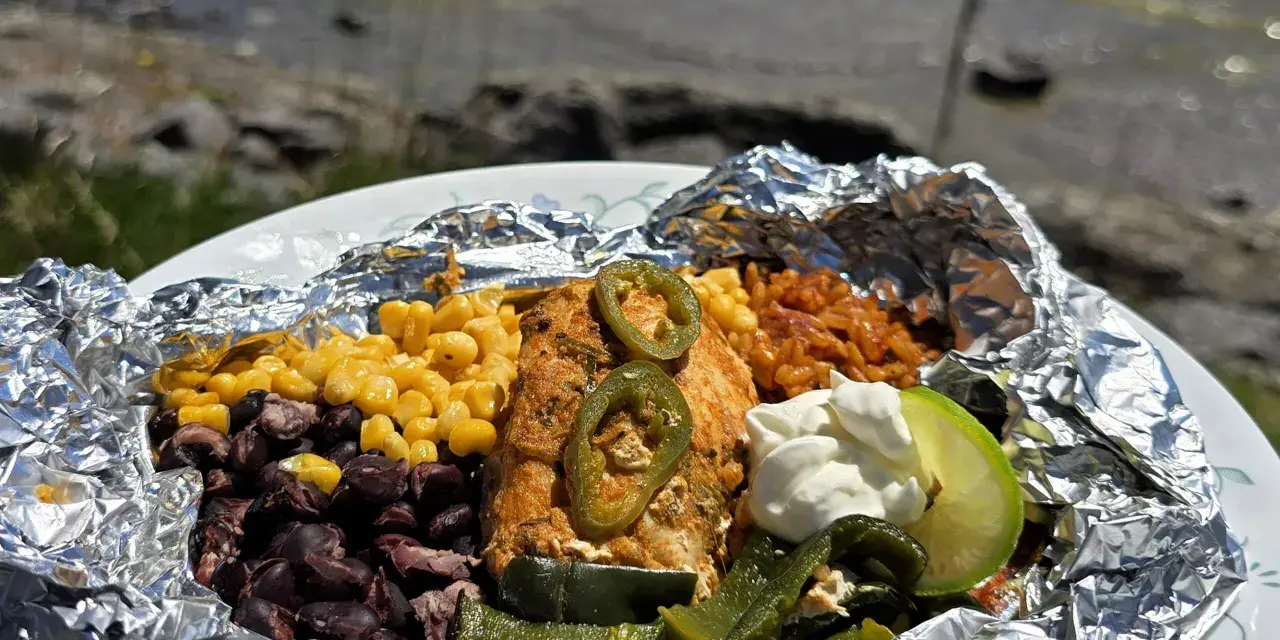
What matters most before the packets go on the fire
- Boneless chicken thighs are the most forgiving choice over uneven campfire heat.
- Use a steady bed of hot coals, not open flames, or the outside will burn before the centre cooks.
- Keep the pieces small and even, especially if you are adding potatoes or other root vegetables.
- Most packets need 25 to 40 minutes, depending on heat and ingredient size.
- For safety, check the thickest piece reaches 75°C / 165°F.
- If you can, assemble the packets at home and chill them in a cool box until cooking time.
Why foil packet chicken works so well over coals
I keep coming back to this kind of camp meal because it solves several problems at once. The packet traps steam, so the chicken cooks gently instead of drying out, and the vegetables pick up flavour from the oil, seasoning, and the chicken juices. That makes it a much better campsite option than a loose pan of food that has to be watched every minute.
It also fits the reality of camp cooking. You are usually dealing with heat that shifts, children who are hungry now, and a pitch where you do not want a pile of greasy pans at the end of the night. A sealed packet gives you a fairly predictable result with minimal equipment. The one thing it does not forgive is a roaring fire, so I always wait for a proper bed of embers before I cook.
Once that part is clear, the recipe becomes much easier to build well.
What I pack into each serving
I like to keep the ingredient list short and practical. That keeps prep easy at home and makes the packets cook at a similar rate. For four servings, this is the balance I use most often.
| Ingredient | Amount | Why it belongs in the packet |
|---|---|---|
| Boneless chicken thighs | 600 g | Stay juicy over uneven heat and are easier to manage at camp |
| Baby potatoes or new potatoes | 400 g, halved | Make the meal more substantial and hold heat well |
| Courgette | 1 medium, thickly sliced | Cooks quickly and adds freshness without needing long fire time |
| Red pepper | 1, sliced | Brings sweetness and a bit of colour |
| Red onion | 1 small, cut into wedges | Softens nicely and gives the packet depth |
| Olive oil | 2 tablespoons | Helps the seasoning cling and stops sticking |
| Smoked paprika, garlic granules, dried thyme, salt, black pepper | 1 to 2 teaspoons each, to taste | Simple seasoning that works in a campsite setting |
| Lemon wedges or chopped parsley | Optional | Brightens the finished dish after cooking |
Read Also: Dehydrating Food for Backpacking - Your Ultimate Guide
Thighs are my default, but breasts can work
If I am cooking for a campsite crowd, I usually choose thighs. They are more forgiving when the heat is patchy, and they stay tender even if the packet sits a little longer than planned. Chicken breast can work too, but I only use it when I cut it into larger, even chunks and watch the cooking time closely. Small breast pieces are much easier to overcook.
If you want to use potatoes without risking underdone centres, I recommend either halving baby potatoes or parboiling larger cubes at home for 5 minutes first. That one step makes a bigger difference than most people expect.

How I build the packets at the campsite
I prefer to do as much of the prep as possible before I leave home, but the assembly itself is straightforward. If the chicken is already seasoned and the vegetables are chopped, all you really need at camp is a flat surface, foil, and a fire that has settled down into glowing coals.
- Cut two sheets of heavy-duty aluminium foil for each packet. If the foil is thin, double it up.
- Toss the chicken with the oil and seasoning first, so every piece is coated before it goes in the packet.
- Put the potatoes at the bottom, then the chicken, then the quicker-cooking vegetables on top.
- Leave a little air space inside the parcel so steam can circulate.
- Fold the foil over tightly and crimp the edges well, but do not flatten the packet completely.
- Label any different flavour variations if you are making several for a family meal.
I like to make the packets in the morning, keep them chilled in a cool box, and cook them later in the day when the fire is ready. That keeps the campsite tidy and makes dinner feel almost effortless. If your campsite only allows barbecue-grade charcoal or a raised fire pit, the method still works as long as the heat is steady.
How long they need and how to tell they are done
The cooking time depends on the cut of chicken, the size of the vegetables, and how hot your coals are. I do not trust colour alone, especially at camp where steam can make chicken look done before it is actually safe. The cleanest answer is a thermometer in the thickest piece of chicken.
| Packet style | Typical heat | Approximate time | What to check |
|---|---|---|---|
| Chicken thighs with quick vegetables | Steady hot coals | 20 to 25 minutes | Chicken should reach 75°C / 165°F in the thickest part |
| Chicken thighs with potatoes | Steady hot coals | 30 to 40 minutes | Potatoes should be fork-tender and chicken fully cooked |
| Chicken breast with vegetables | Medium-hot coals | 18 to 25 minutes | Watch closely; breast dries out faster than thigh meat |
I usually turn the packets once about halfway through if the fire is uneven, but I do not fuss with them too much. Constant opening lets steam escape, which slows the cook and dries out the food. If the packets are not ready when you check them, reseal them and give them another 5 to 10 minutes over the coals.
For UK-style food safety, a core temperature of 70°C held for 2 minutes is the usual standard. On a campsite, I still find 75°C easier to target because a pocket thermometer gives a clearer buffer when the heat is unpredictable.
Flavour combinations that suit a campsite
The best thing about packet cooking is that the base method stays the same while the flavour changes completely. I prefer seasonings that feel complete without requiring a lot of extra ingredients or a separate sauce.| Style | What to add | Why I like it at camp |
|---|---|---|
| Lemon and herb | Lemon zest, thyme, parsley, courgette, new potatoes | Fresh, light, and good if the rest of the camping menu is fairly rich |
| Smoky paprika | Smoked paprika, garlic, sweetcorn, red onion, pepper | Feels a little more like barbecue food and is usually a hit with children |
| Mediterranean | Oregano, cherry tomatoes, olives, courgette, feta after cooking | Bright and savoury without needing a heavy sauce |
| BBQ style | A little barbecue sauce, red onion, peppers, corn | Useful for a bigger group, but I add the sauce lightly so it does not burn |
My rule is simple: if the flavouring is very wet or very sweet, I use it sparingly before cooking and finish with the rest afterwards. That keeps the packet from turning soggy or sticky. Fresh herbs, cheese, and a squeeze of lemon all work better at the end than at the start.
Common mistakes that ruin the result
Most bad foil packets fail for the same few reasons. Once you know them, they are easy to avoid.
| Mistake | What goes wrong | How I fix it |
|---|---|---|
| Using pieces that are too large | The chicken and vegetables finish at different times | Cut everything to a similar size, and keep potatoes smaller than the chicken pieces |
| Cooking over open flames | The outside chars before the centre cooks | Wait for coals or lower, steadier heat |
| Overfilling the packet | Steam cannot circulate properly and the food steams unevenly | Use two packets instead of one overloaded parcel |
| Skipping oil | Seasoning does not cling and food can stick to the foil | Toss everything with a little oil before sealing |
| Underestimating raw potatoes | Chicken can be done while the potatoes stay firm | Use baby potatoes, cut smaller, or parboil them first |
| Relying on colour alone | Juicy-looking chicken can still be undercooked | Check the thickest piece with a thermometer |
If I had to pick one mistake to avoid, it would be the fire itself. Good packet cooking depends on patience more than flame. Give the coals time to settle, and the rest of the meal becomes much easier.
The way I would pack this for a family campsite dinner
For a family trip, I like a meal that can be prepared in advance and cooked without much supervision. This is one of those dinners. I season the chicken at home, keep the vegetables in separate containers, and store everything in the cool box until the fire is ready. That way, the campsite work is mostly assembly rather than actual cooking.
I also like to make one mild packet and one slightly more seasoned version. That solves the usual family problem: one person wants stronger flavour, another wants something plain, and nobody wants a second cooking pan to wash. Serve the packets with crusty bread, flatbreads, or a simple salad, and the meal feels complete without becoming complicated.
It is also a sensible choice for European camping because it adapts well to what you can actually carry. If you have courgettes, peppers, new potatoes, and a few herbs, you already have enough for a very solid dinner.
The small fire-side checks that make this dinner smoother
Before I put the packets down, I make sure the tongs, a heatproof tray, and the thermometer are within reach. That sounds basic, but at camp it saves a lot of awkward back-and-forth once the food is hot. I also keep a folded tea towel or heatproof glove nearby so I am not trying to open steaming foil with bare hands.
- Let the packets rest for 2 minutes before opening them.
- Open the foil away from your face because steam builds up fast.
- Finish with lemon, herbs, or a little butter after cooking, not before.
- Put the serving plates or flatbreads out before the food comes off the fire.
That last bit matters more than it sounds. When the food is hot and everyone is hungry, the easiest dinner is the one that can move straight from the coals to the table. That is why I keep returning to this style of camping meal: it is simple, forgiving, and genuinely useful rather than just decorative.
