
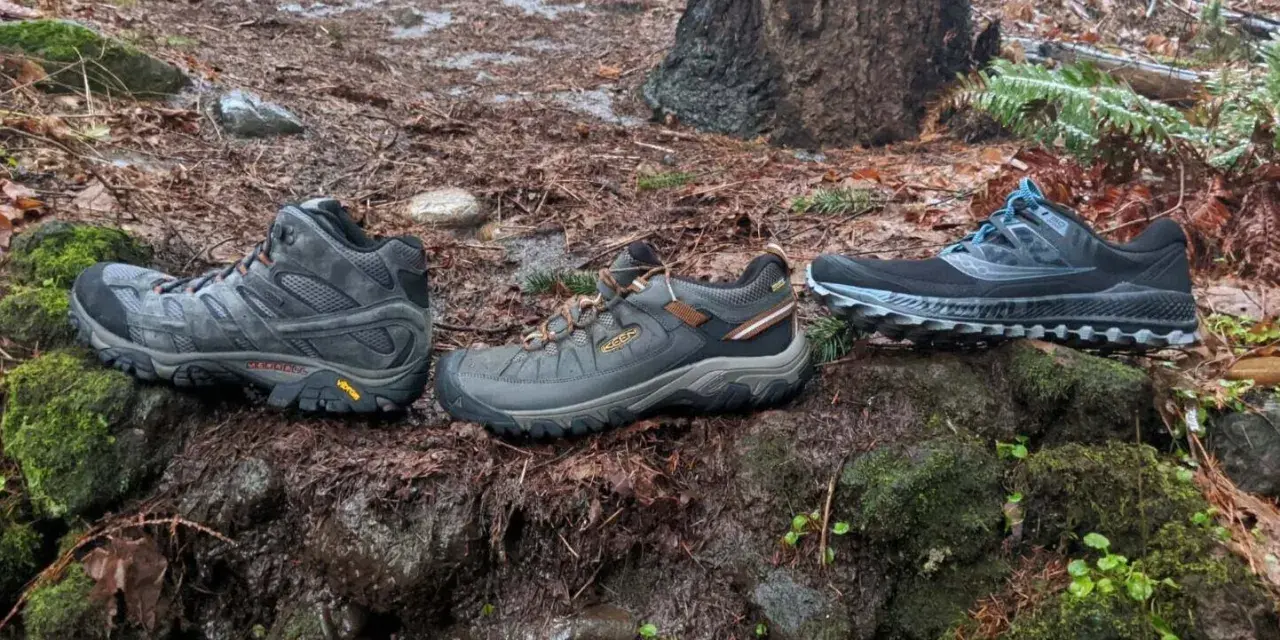
The trail running shoes vs hiking shoes choice is rarely about which one is universally better; it is about how you move, how much you carry, and how rough the ground is underfoot. Trail models are lighter and more agile, while hiking shoes usually give you a firmer platform, more protection, and better all-day structure. For UK paths that can switch from dry towpath to slick mud in one afternoon, that difference matters more than people expect.
The right pair depends on pace, load, and terrain
- Trail running shoes feel lighter and faster, with more flex underfoot.
- Hiking shoes usually add structure, protection, and durability for longer days.
- On wet British ground, grip quality and fit matter more than the logo.
- If you carry a heavier pack or walk uneven terrain all day, hiking shoes usually make more sense.
- If you want to move quickly with a light load, trail runners are the better tool.

How they differ when you actually wear them
On paper, the categories can look close. In practice, they feel different after the first steep climb, the first muddy descent, and the first long stretch when your feet start swelling a little. I think of trail shoes as speed-first footwear and hiking shoes as stability-first footwear, even when both are low-cut and reasonably light.
| Feature | Trail running shoes | Hiking shoes | What it means on the trail |
|---|---|---|---|
| Weight | Usually lighter and less bulky | Usually heavier because of tougher materials | Trail shoes reduce fatigue when you are moving quickly |
| Flexibility | More flexible, especially through the forefoot | More structured and often stiffer | Trail shoes roll more naturally; hiking shoes feel steadier on rough ground |
| Support | Moderate support with a more natural feel | More built-in support and side protection | Hiking shoes handle load better over a full day |
| Protection | Protective enough for many trails, but still focused on agility | More reinforced uppers, toe caps, and abrasion resistance | Hiking shoes are better when rocks, roots, and repeated kicking are a factor |
| Traction | Often tuned for fast grip and varied trail surfaces | Often tuned for steady grip and durability | Trail shoes can feel sharper at pace; hiking shoes can feel calmer when loaded |
| Break-in | Usually minimal | Sometimes a short break-in period | Trail shoes are easier if you need something ready immediately |
| Weather handling | Often drains and dries faster | Often better at blocking wet and abrasion, especially in waterproof versions | Trail shoes suit stream crossings and mixed conditions; hiking shoes suit sustained wet days |
The key point is that modern designs overlap more than they used to. Some trail runners now have real protection and aggressive outsoles, while some hiking shoes feel surprisingly nimble. That overlap is useful, but it also means the label is less important than the actual build of the shoe. Once you see those design differences, the next question is where each one actually makes sense on real ground.

Where each pair shines on UK trails
For British conditions, I look at three things first: how fast you want to move, how wet the ground is likely to be, and whether you are carrying much at all. That simple filter usually makes the decision obvious.
Fast, light days
Trail runners are at their best on days when you want to cover ground efficiently. Think canal towpaths, forest loops, dry bridleways, and hill sessions where the pack is light and the pace is brisk. If you are running between stops, hopping over puddles, or going out for a family walk that might turn into an unplanned jog, the lower weight and easier flex of a trail shoe makes a real difference.
Longer walks with a pack
Hiking shoes make more sense when the day is longer, the ground is rougher, or the bag on your back is no longer trivial. A loaded day on the Lake District fells, a stretch of Dartmoor, or a wet and uneven route in the Scottish hills can all benefit from the extra structure. The shoe does not have to be heavy to be supportive, but it does need enough stiffness to help the foot stay composed when fatigue sets in.
Mixed family days
For family outings, I often find the sweet spot is either a rugged trail runner or a light hiking shoe. Those days usually involve stop-start pacing, a bit of tarmac, a bit of grass, a snack break, and a few sudden detours because someone spotted a viewpoint or a stream. In that situation, comfort matters more than pure speed, but full hiking stiffness can feel like overkill. The best choice is the one that keeps everyone moving without needing constant adjustment.
If I had to reduce it to one rule, I would say this: the more your day looks like walking with occasional running, the more trail runners make sense; the more it looks like a long, committed hike, the more hiking shoes earn their keep. The details inside the shoe decide whether that rule holds up in bad weather, which is where the next section matters.
The features that matter more than the label
People often compare shoe names and miss the parts that actually change the experience. I pay closer attention to four things: outsole grip, midsole stiffness, upper protection, and fit. Those are the details that decide whether a shoe feels confident or annoying after hour three.
Outsole and lugs
Lugs are the raised blocks on the outsole, and they do most of the actual gripping. Deeper, more aggressive lugs bite better in mud and loose ground, which is why they matter so much on British winter paths. Flatter patterns feel smoother on hard-packed trails and a bit of pavement, but they can lose bite when the ground gets soft. A sticky rubber compound can help on wet rock, though it will not magically solve every slippery descent.
Midsole and rock plate
The midsole is the layer that cushions and shapes the ride. Trail runners usually use it to balance bounce, flexibility, and ground feel, while hiking shoes often lean toward a firmer, more supportive platform. Some shoes also include a rock plate, which is a thin protective layer that shields the foot from sharp stones without turning the shoe into a boot. If your local routes are rocky, that layer can make a big difference to underfoot fatigue.
Upper materials and waterproofing
Mesh uppers breathe better and usually dry faster. Reinforced synthetics and leather-style constructions hold up better against abrasion and give more weather resistance. Waterproof membranes can be useful in persistent British drizzle, wet grass, and shallow puddles, but they also tend to run warmer and dry more slowly from the inside once water gets in. That trade-off is easy to miss. I would choose waterproofing for cold, wet conditions and skip it for warmer, faster, or more mixed summer use.
Read Also: Hammock Camping UK - Stay Warm & Dry in British Weather
Fit and toe room
Fit matters more than most people want to admit. I like about a thumbnail’s width of space in front of the longest toe when I am standing, because descents push your foot forward and long outings make feet swell. Heel hold matters just as much: if the heel slips, the shoe will feel sloppy no matter how good the outsole is. A shoe that fits correctly on the first try is almost always more useful than a technically better shoe that rubs by mile six.
Those features are what really decide comfort, but they become easier to read once you apply them to a real trip and a real budget, which is the next step.
How I would choose for different trips
In the UK market, I would expect to pay roughly £90 to £170 for a solid pair of trail running shoes and £100 to £190 for a good pair of hiking shoes, with premium waterproof or technical models going higher. The overlap is real, so I would not choose by price alone. I would choose by the route and the load.
| Trip type | Better pick | Why |
|---|---|---|
| Short, muddy woodland loop | Trail running shoes | Lighter feel, quicker drying, and enough grip for fast footwork |
| Full-day hill walk with snacks, layers, and water | Hiking shoes | More structure and better support when fatigue builds |
| Wet autumn paths and grassy tracks | Waterproof hiking shoes or waterproof trail runners | Waterproofing helps, but only if you accept slower drying and a warmer feel |
| Rocky ground or light scrambling | Hiking shoes or technical trail runners | Protection and stability matter more than a soft, fast ride |
| Fastpacking or long-distance days with a light kit | Trail running shoes | Lower fatigue and a more efficient stride over many hours |
| Mixed family weekends with varied surfaces | Rugged trail runners or light hiking shoes | The middle ground is often the most practical choice |
My rule of thumb is simple. Choose trail runners if pace, lightness, and quick transitions matter most. Choose hiking shoes if the day is long, the terrain is rough, or the pack is heavy enough to change the way you walk. If you sit between those two, a light hiking shoe or a more protective trail runner usually gives the best compromise. That decision sounds straightforward, but a few common mistakes still trip people up.
Common mistakes that turn a good shoe into a bad day
The worst footwear problems are usually not dramatic. They are small misjudgments that become painful after a couple of hours. I see the same mistakes again and again.
- Buying for the first kilometre instead of the last five. A shoe that feels fun at the start can feel unstable once your feet are tired.
- Ignoring pack weight. The more you carry, the more you benefit from structure and a firmer platform.
- Choosing waterproof by default. Waterproofing is useful, but it is not always the best answer in warmer, mixed, or faster conditions.
- Underestimating downhills. If your toes hit the front of the shoe every time you descend, the fit is wrong even if the upper feels fine.
- Assuming all trail shoes handle mud equally well. Lug depth and rubber compound matter a lot more than the category name suggests.
- Using hiking shoes for running and expecting the same agility. You can jog in some hiking shoes, but they will usually feel slower and more rigid.
The simplest fix is to test the shoes in the movement you actually plan to do. Walk a slope, turn quickly, brake on a descent, and see whether the shoe disappears on your foot or keeps reminding you it is there. That test says more than a showroom try-on ever will.
The pair I’d pick for most mixed UK weekends
If I were buying for one pair to cover the widest range of UK weekend use, I would lean toward a light hiking shoe with enough flexibility to feel natural, or a rugged trail runner if speed and lower weight mattered more than protection. That choice covers campsite walks, damp paths, family outings, and day hikes without feeling extreme in any one direction.
For dedicated runners, trail shoes stay the better tool. For committed hikers, hiking shoes are still the more dependable option. The honest answer is that the right shoe is the one that matches your routes, your pack, and the way you like to move, not the one that sounds more impressive on the box. If you keep that in mind, the decision gets a lot easier and your feet usually notice the difference before you do.
