
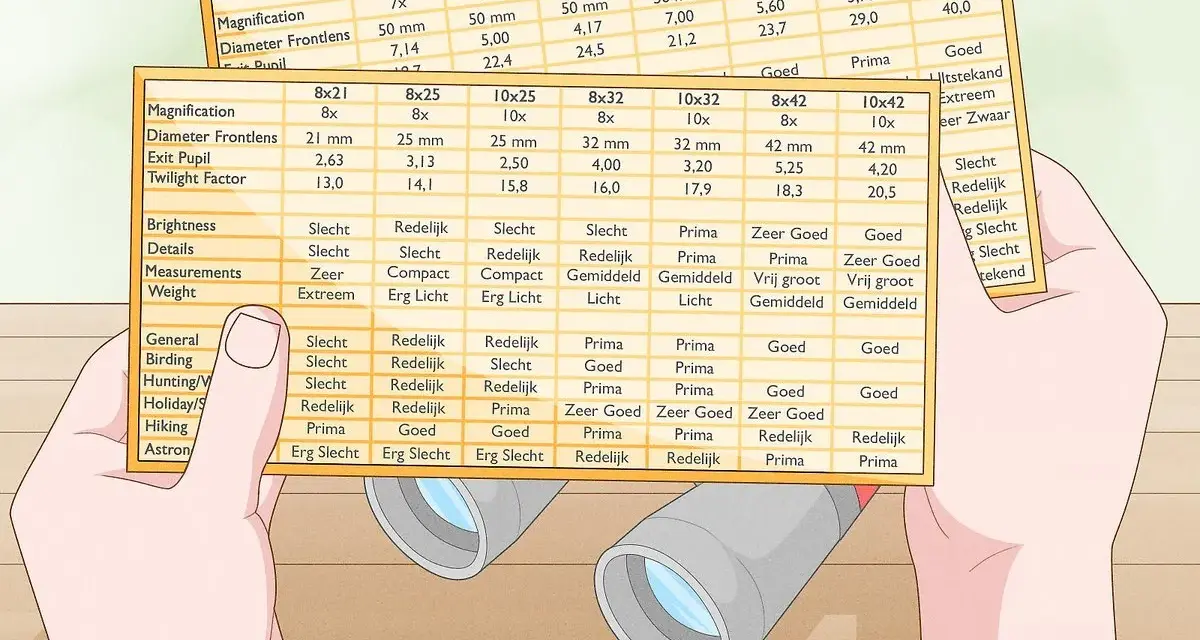
Binocular numbers look cryptic at first, but they usually tell you almost everything you need to know about how a pair will behave in the field. This guide breaks down what the numbers on binoculars mean, how they affect brightness, steadiness, and comfort, and which specs make sense for camping, wildlife watching, and family outings in the UK.
The two main numbers tell you most of the story
- The first number is magnification, so 8x makes a subject appear eight times larger.
- The second number is the objective lens diameter in millimetres, which affects light gathering and bulk.
- Higher magnification is not automatically better because it narrows the view and magnifies hand shake.
- Larger objective lenses can help at dawn, dusk, and in woodland shade, but they add weight.
- Extra markings such as field of view, eye relief, and close focus often matter more than buyers expect.
Start with the two numbers that matter most
Take a label like 8x42 or 10x50. The first number is the magnification, and the second is the size of the front lenses, measured in millimetres. In plain English, an 8x42 pair makes a distant object look eight times larger than with the naked eye, while the 42 mm objective lenses help determine how much light the binoculars can gather.
I usually read that label as a trade-off, not a score. The first number is about reach, the second is about light and size. A pair with big numbers is not automatically better; it is just doing a different job. That matters on a damp evening in the Lakes or during a late campsite walk, where you want a view that is bright enough and steady enough to enjoy for more than a minute.
Once you know that, the next step is understanding how magnification changes the way binoculars feel in real use.
Magnification is about reach, not just power
Magnification tells you how large the subject appears, but it also changes how easy the binoculars are to use. An 8x model is usually easier to hold steady than a 10x model, and both are far more manageable than 12x or 15x if you are holding them by hand for long stretches.
That is why I tend to steer casual walkers, families, and most campers toward 8x or 10x. For birds on a hedgerow, deer on a hillside, or a view across a loch, 8x often gives enough reach without making the image feel nervous. Ten times magnification gives a little more detail, but it also narrows the field of view and makes shake more obvious.
- 8x is the easiest all-round choice for handheld use.
- 10x gives more reach, but you need a steadier hand.
- 12x and above can be useful, but they are less forgiving unless you use support or image stabilisation.
If you only remember one thing, remember this: more magnification is useful only when you can actually hold the image still enough to enjoy it. That brings us to the second number, which quietly shapes brightness and portability.

The second number tells you how bright and bulky the binoculars will feel
The second number is the objective lens diameter in millimetres. Bigger lenses can gather more light, which usually helps in low-light situations such as twilight, shaded woodland, or early-morning wildlife watching. They also make the binoculars heavier and sometimes harder to carry all day.
For a quick mental picture, compare these common sizes:
| Format | What it feels like | Best for | Main trade-off |
|---|---|---|---|
| 8x25 | Very compact and light | Travel, festivals, quick walks | Less forgiving in low light |
| 8x32 | Balanced and easy to carry | General outdoor use, family trips | Not as bright as 42 mm models |
| 8x42 | Full-size but still manageable | Camping, wildlife, mixed conditions | Heavier than compact models |
| 10x42 | More reach with similar size to 8x42 | Birds at distance, open landscapes | Harder to hold steady |
| 10x50 | Bright and substantial | Dusk viewing, astronomy-style use | Bulkier for long walks |
For most outdoor use, I see 8x32 and 8x42 as the safest all-round choices. If you want something you will actually carry everywhere, the smaller format often wins. If you care more about dusk performance and comfort in dim conditions, the larger objective lens earns its keep. That balance makes a lot more sense once you look at the number hidden behind the label.
The hidden number behind low-light performance
According to Nikon, exit pupil is the objective lens diameter divided by the magnification. That sounds technical, but it is easy to use. For an 8x42 binocular, the exit pupil is 5.25 mm. For a 10x42, it is 4.2 mm. For a 10x50, it is 5 mm.
Why should you care? Because exit pupil helps explain how forgiving the binoculars feel when you are looking through them. A larger exit pupil is generally easier to line up with your eyes and can be more comfortable in poor light. A smaller one can still work perfectly well, but it asks more of your eyes and the viewing conditions.
Here is the practical version I use:
- About 3 mm is fine for compact daytime binoculars.
- About 4 to 5 mm is a very useful range for general outdoor use.
- Above 5 mm can feel comfortable in low light, especially at dusk.
This is also why two pairs with similar magnification can feel very different. An 8x25 and an 8x42 both say 8x, but the larger pair usually feels brighter and easier at the edges of the day. Once you understand that, the extra markings start to make far more sense.
The extra markings that decide comfort in real use
Binocular spec sheets often include more than the headline numbers, and these extras can matter just as much. I pay close attention to field of view, eye relief, and close focus because they change how the binoculars behave outside, not just how they look on paper.
| Marking | What it means | Why it matters |
|---|---|---|
| Field of view | The width of the scene you can see, often shown as metres at 1,000 metres or degrees | A wider view makes it easier to find birds, follow movement, or scan a hillside |
| Eye relief | The distance from your eye to the eyepiece where you still see the full image | Important for glasses wearers and for comfortable, full-frame viewing |
| Close focus | The nearest distance at which the binoculars stay sharp | Useful for insects, flowers, campsite details, and family nature walks |
Field of view is one of the most underrated numbers. A wider field makes it easier to find something moving quickly, which is useful for birds, deer, or children wandering ahead on a trail. Eye relief matters if you wear glasses; RSPB notes that around 16 mm is a useful target for many glasses wearers. Close focus is the one people ignore until they try to look at butterflies or a marker on a campsite and realise the binoculars cannot focus close enough.
In other words, the headline code gets you in the right ballpark, but these extra measurements decide whether the binoculars actually feel pleasant to use for more than five minutes.
Which binocular numbers make sense for camping and outdoor use
If I had to choose binoculars for mixed outdoor use in the UK without overcomplicating it, I would match the numbers to the way they will really be carried. A hill walk, a family campsite, and a dawn birding session all reward slightly different compromises.| Likely use | Good starting point | Why it works | When I would choose something else |
|---|---|---|---|
| General camping and walking | 8x32 or 8x42 | Easy to hold, versatile, and bright enough for most conditions | Go smaller if pack weight matters most |
| Birdwatching and wildlife | 8x42 or 10x42 | Good balance of detail, brightness, and practicality | Choose 8x if you want steadier viewing |
| Long-distance views | 10x42 or 10x50 | More reach for hills, coastlines, and open ground | Drop back to 8x if the image feels too shaky |
| Travel and day bags | 8x25 | Light, compact, and easy to carry everywhere | Step up in size if you often watch at dusk |
| Children and family use | 8x32 | Light enough to handle, simple to keep steady | Use 7x or 6x if hand shake is a big issue |
My practical rule is simple: 8x32 or 8x42 for most people, 10x42 if you know you want a bit more reach. That advice holds up especially well on family trips, where comfort and ease of use matter more than chasing the largest number on the box. If you are shopping with glasses, though, you should check one more spec before you decide.
A quick reading rule that keeps you from overbuying
The fastest way to read binocular specs is to ask three questions in order: How much magnification do I really need? How much weight am I willing to carry? Will I use them in low light or wear glasses? Those three answers tell you far more than a big-sounding label ever will.
Here is the rule I use in the shop and on trips: start with the lowest magnification that still gives you the detail you need, then choose the largest objective lens you are happy to carry, and finally check field of view and eye relief for comfort. That keeps you from buying a pair that looks impressive on paper but feels awkward on a windy coastal path or during a long day outdoors.
If you want the simplest possible takeaway, read the first number for reach, the second for light and bulk, and the extra numbers for comfort. Once you see binoculars that way, the label stops being jargon and starts becoming a practical buying tool for your next walk, camp, or wildlife trip.
