
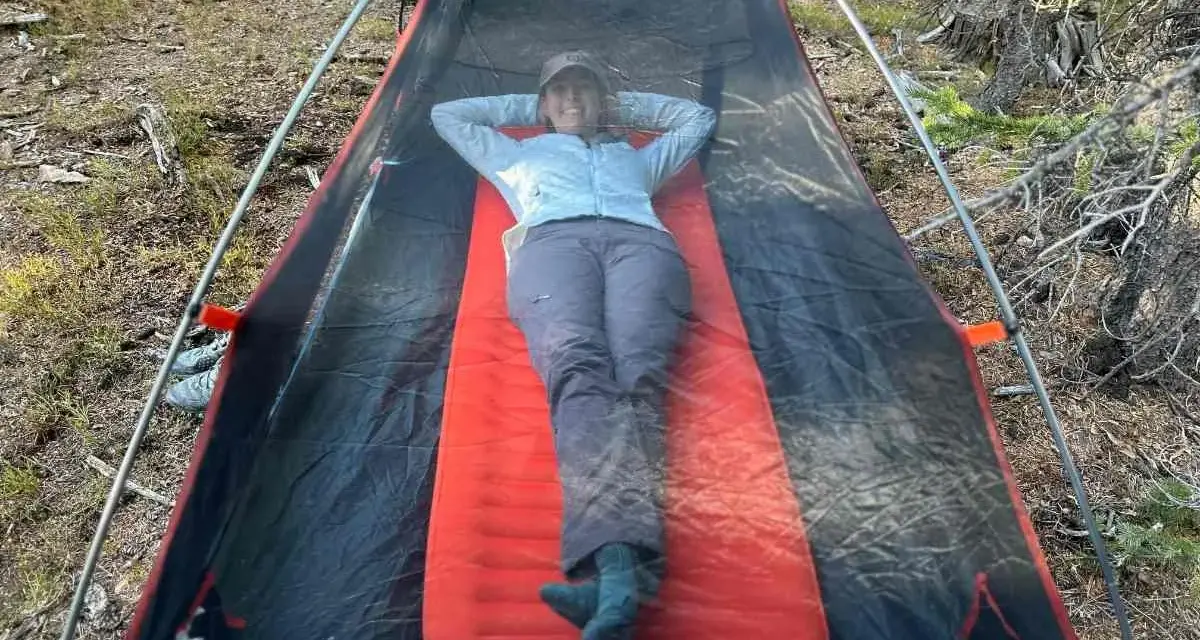
Key facts to know before buying
- The NeoLoft is a backpacking pad with a comfort-led design, not a pure ultralight race pad.
- All sizes carry a 4.7 R-value, which puts it in Therm-a-Rest’s year-round insulation band.
- The pad is 4.6 inches thick, with side rails and a broad sleep surface that help restless sleepers stay centred.
- Regular Wide is the sweet spot for many campers at 850 g, while Regular is 710 g and Large is 910 g.
- The package includes a stuff sack, high-volume pump sack and repair kit.
- If you value sleep more than shaving every gram, this is one of Therm-a-Rest’s most interesting current pads.
What the NeoLoft is built to do
Therm-a-Rest clearly designed this pad for campers who want real comfort without moving all the way to a bulky car-camping mattress. The numbers tell the story: a 4.7 R-value, 4.6 inches of loft, a stretch-knit top, and side rails that help keep you centred instead of drifting toward the edge. It is also not a NeoAir construction, which matters because the internal structure is tuned more toward support and contouring than absolute minimal pack size.
I think that is the right design call if you often wake up because a narrow pad feels twitchy, not because the tent is cold. This is the kind of gear that makes you notice the difference the next morning, especially on trips where poor sleep would ruin the following day.
| Size | Weight | Dimensions | Packed size |
|---|---|---|---|
| Regular | 710 g | 56 x 185 cm | 24 x 14 cm |
| Regular Wide | 850 g | 66 x 185 cm | 29 x 15 cm |
| Large | 910 g | 66 x 198 cm | 29 x 15 cm |
The main takeaway is simple: the NeoLoft is not trying to win a spreadsheet. It is trying to make a backpacking bed feel calmer, thicker and more forgiving. From here, the next question is whether that comfort actually translates into a better night’s sleep.
How warm and stable it feels through the night
A 4.7 R-value puts the pad in a sensible year-round zone, which is a useful fit for many UK and European trips. For spring, summer and autumn camping, that level of insulation is usually enough that the ground is not the limiting factor. For deep winter or frozen terrain, I would still reach for something warmer, and Therm-a-Rest’s XTherm line is the obvious step up.
What makes the NeoLoft interesting is that the warmth is paired with a very stable feel. The broad, taper-free shape gives you more usable surface than a classic narrow air pad, while the raised side chambers help keep your body centred. That sounds like a small detail until you sleep on it as a side sleeper or roll around a lot during the night; then it becomes the difference between feeling held in place and feeling like you might slide off the edge.
The stretch-knit face fabric also matters more than a spec sheet suggests. It softens the contact point and helps the pad conform a little to your body, which reduces the hard, overinflated feel that bothers many people on simpler air mats. In practice, I’d describe the NeoLoft as supportive first and plush second, but still much closer to a proper mattress feel than a standard backpacking pad.
That balance is why size choice matters so much. If the pad is the wrong width or length for your body, you lose a lot of the comfort advantage.

Which size fits your body and your tent
For most buyers, the size decision is where the real trade-off lives. Regular is the lightest choice and works well if you sleep fairly straight. Regular Wide is the most sensible default for comfort-focused campers, and Large is mainly about extra length for taller sleepers rather than extra width.
| Size | Best for | Why I would choose it |
|---|---|---|
| Regular | Minimal solo use | It is the lightest option and fits tighter solo tents more easily. |
| Regular Wide | Side sleepers and restless sleepers | The 66 cm width gives you more room to move and reduces the “edge” feeling. |
| Large | Taller campers | The extra length matters if shorter pads leave your feet hanging near the end. |
Therm-a-Rest says most 2-person backpacking tents are typically 127 to 132 cm wide at the floor and 223 to 229 cm long. In a 132 cm tent, two Regular Wides or two longer pads can fit, while in a 127 cm tent two wide pads will start to crowd the sides. That does not make the pad a bad fit; it just means the tent is the bottleneck.
In practical UK terms, that matters because many trekking tents taper harder than their headline dimensions suggest. I would be cautious about buying the wide version for a very narrow 2-person tent unless I had already checked the usable floor space rather than just the marketing width.
Once you know which size works, the next useful comparison is whether the NeoLoft is the right Therm-a-Rest pad for your kind of trip at all.
Where it sits against lighter and warmer alternatives
If I compare the NeoLoft inside Therm-a-Rest’s current range, it lands in a very specific gap. It is far more comfortable than the NeoAir XLite NXT, but also much heavier. It is not as warm as the XTherm NXT, but it feels far more mattress-like than the classic ultralight options. At the time of writing, Therm-a-Rest lists it from $249.95 in the US, so the value question is really about what kind of sleep you want to pay for.
| Pad | Best for | Weight | R-value | Trade-off |
|---|---|---|---|---|
| NeoLoft | Comfort-first backpacking | 710 to 910 g | 4.7 | Plush and stable, but not the lightest |
| NeoAir XLite NXT | Three-season backpacking | 370 g | 4.5 | Much lighter, less mattress-like |
| NeoAir XTherm NXT | Winter and frozen ground | 440 g | 7.3 | Warmer, but focused on performance rather than luxury feel |
| MondoKing 3D | Car camping and basecamp | 1.99 kg | 7.0 | Huge comfort, but far too bulky for most hiking trips |
That comparison is the cleanest way to read the NeoLoft. If you want the lightest sensible pad, buy the XLite NXT. If you want the warmest pad for serious cold, buy the XTherm NXT. If you want a proper mattress for the boot of the car, buy the MondoKing 3D. The NeoLoft exists for the people in between, and that group is bigger than gear marketing sometimes admits.
For UK buyers, that middle ground makes a lot of sense on weekend hikes, shoulder-season trips and family camps where a few extra hundred grams buy you a noticeably better night.
How to inflate, use and look after it
The TwinLock valve system is one of the most practical parts of the design. Therm-a-Rest pairs it with a high-volume pump sack, and the pad also comes with a repair kit and stuff sack. In plain terms, that means setup and pack-down are easier than on many simpler inflatables, and you are not left improvising if you pick up a small puncture on a trip.
- Use the pump sack if you want a faster, drier setup or if the weather is cold and damp.
- Inflate gradually and stop before the pad feels rock hard; comfort pads usually sleep better with a little give.
- Keep the tent floor clear of grit, thorns and sharp stones before you unroll the pad.
- Carry the repair kit on longer trips, especially on rough ground where punctures are more likely.
- Clean it by hand with water and a mild household cleaner, and do not put it in a washing machine.
If I were using it on a wet British evening, I would reach for the pump sack instead of relying on breath alone. That is less about fussiness and more about keeping moisture out of the system while making the inflation process consistent. Once you treat it as a premium inflatable rather than a throw-it-anywhere mat, it should stay reliable for years.
That leaves one final question: who should actually buy it, and who should skip it without overthinking the rest of the range?
The best fit for UK campers who value sleep over gram counting
For me, the NeoLoft makes the most sense when the walk to camp is real, but the sleep system still has to feel civilized. That covers a lot of UK and European use cases: weekend backpacking in the Lake District or Snowdonia, family camps with a short walk to the pitch, and shoulder-season trips where poor sleep would spoil the following day.
- Choose it if you are a side sleeper or a restless sleeper who hates narrow pads.
- Choose it if you want comfort close to a car-camping mattress without jumping to a huge, heavy mat.
- Skip it if you are chasing the lightest possible pack for long-distance trekking.
- Skip it if deep winter warmth matters more to you than a softer sleep surface.
If I were buying one pad for mixed UK use in 2026, I would shortlist the Regular Wide first and then check my tent floor width before ordering. That single check matters more than most people think, because a comfort pad only stays comfortable when it actually fits the space you sleep in. If that fits your setup, the NeoLoft is one of the few backpacking pads that genuinely makes the bed feel better rather than just smaller.
