
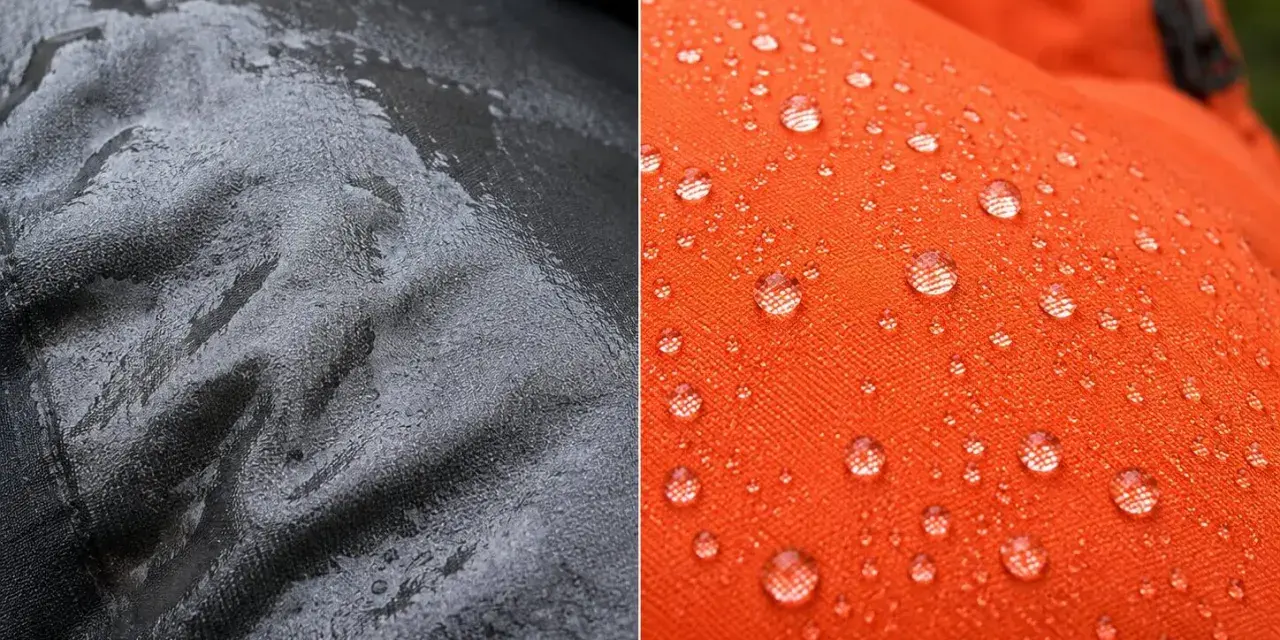
Wet-weather gear works best when the outer face sheds water cleanly. A DWR coating is the thin water-repellent layer that helps rain bead on the surface instead of soaking into the fabric, which keeps shells lighter, less clammy and easier to wear on long damp walks. In UK conditions, that difference matters on everything from rain jackets to gloves, trousers and some tent fabrics. This guide breaks down what the finish does, how to spot failure, and how to restore it without wasting money or damaging the gear.
Why the outer finish matters more than most people think
- The outer layer is there to shed water, while the membrane or coating underneath handles true waterproofing.
- When the face fabric absorbs water, gear feels heavier, colder and less breathable even if it has not leaked.
- Cleaning often restores performance before any reproofing product is needed.
- Spray-on, wash-in and heat reactivation solve different problems, so the method should match the gear.
- By 2026, many brands are moving to PFAS-free finishes, but the care routine still matters.
What a DWR finish actually does on outdoor fabrics
At its simplest, this finish changes how water behaves on the outer surface. Instead of spreading out and soaking in, droplets stay rounded and roll off. That sounds minor until you spend a day in drizzle or walking through wet grass, because the difference between beading and saturation is the difference between kit that feels fresh and kit that feels tired halfway through the walk.
I think of it this way: the face fabric is the part that takes the abuse, while the membrane or coated layer underneath is what actually blocks water. The outer treatment protects that face fabric from becoming waterlogged, which also helps the garment breathe more effectively. Once the outside is soaked, moisture has a harder time moving out, so you feel clammy long before you are technically leaking.
- On jackets and trousers, it reduces that cold, heavy feeling in steady rain.
- On gloves and softshells, it helps the surface resist light showers and drying time stays shorter.
- On some tent flies and pack covers, it helps water run off instead of sitting in the weave and dragging dirt with it.
That is the basic job of the finish, but it only makes sense when you know where it helps and where it stops.
Where it helps and where it does not
The mistake I see most often is assuming the water-repellent finish is the whole waterproof system. It is not. It is a support layer, not the main barrier. That matters because the right fix depends on which part of the gear is failing.
| Gear item | What the finish helps with | What still does the real waterproofing |
|---|---|---|
| Rain jackets and trousers | Keeps the outer face from saturating and getting heavy | The membrane, laminate and seam sealing |
| Softshells and gloves | Slows down wetting in drizzle and light showers | The fabric structure and any inner lining |
| Tent flies and vestibules | Helps rain and dirt run off more cleanly | The waterproof coating and seam construction |
| Backpack covers and fabric packs | Improves runoff and reduces surface soaking | The cover fabric, closures and any liner inside the pack |
| Textile footwear uppers | Helps treated panels shed spray and mud | The shoe’s membrane, construction and material-specific care |
If a garment leaks at the seams, zipper area or through damaged fabric, DWR is not the fix. That is a construction problem, not a surface-treatment problem. Once you separate those two ideas, maintenance becomes much simpler.

How to tell when the finish is wearing off
The easiest test is visual. Spray or drizzle a little clean water on the outer face and watch what happens. If droplets stay rounded and move off quickly, the surface is still doing its job. If they flatten, darken the fabric or soak in almost at once, the finish is weakening or already clogged with grime.
| What you notice | What it usually means | What I would do next |
|---|---|---|
| Water beads at first, then spreads | The surface is dirty or the finish is tired | Wash the item before reaching for a reproofing product |
| The outer face turns dark in rain | The fabric is wetting out | Clean it, then try heat if the care label allows it |
| The garment feels heavy after a short shower | The face fabric is holding water | Restore the surface repellency and check for wear zones |
| Shoulders, cuffs and hood fail first | High-abrasion areas have worn down | Target those zones when you reproof |
| It still feels clammy inside | Wet-out is reducing breathability | Fix the surface first before blaming the membrane |
In practice, wet-out is often mistaken for a leak. That is why people replace good gear too early. If the inner layer is still intact, the outer finish may be the only thing that needs attention.
How to restore it without damaging the gear
I always start with cleaning. Dirt, body oils, sunscreen residue and smoke all interfere with water beading, so a filthy shell cannot tell you whether the finish is actually gone. Clean first, then test again, then decide whether reproofing is needed. That sequence is the one I trust because it avoids unnecessary products and avoids locking grime into the fabric.
- Check the care label and use the gentlest washing method the maker allows.
- Wash with a technical cleaner or a mild liquid detergent that leaves no softening residue.
- Avoid fabric softener, bleach and powder detergents, because they can reduce repellency.
- Dry the item in the way the label permits. Some finishes respond well to low or medium heat.
- Test with clean water before deciding whether you need a fresh repellent treatment.
For a lot of kit, that is enough. If the surface still beads badly after a proper wash and the recommended heat step, then a reproofing product makes sense. If not, you have probably solved the problem already and saved yourself from adding an unnecessary layer of product.
One rule I keep in mind is that reproofing never comes before washing. A new treatment on dirty fabric is wasted effort, and often it performs worse than the original finish did when it was clean.
Spray-on, wash-in or heat activation works best in different cases
The right method depends on what the garment looks like inside and out. There is no single answer that works for every shell, tent or accessory, which is why I like to compare them rather than treat them as interchangeable.
| Method | Best for | Strength | Limit |
|---|---|---|---|
| Spray-on treatment | Layered garments, lined jackets, gloves, tents and mixed materials | Lets you treat only the outer face | Takes longer and needs careful coverage |
| Wash-in treatment | Simple unlined shells and straightforward technical clothing | Fast, even coverage across the whole item | Less useful if you do not want to treat inner fabrics |
| Heat activation | Factory finishes that respond to warmth after washing | No extra product needed if the surface is still healthy | Only works when the label allows it and the finish is still there |
If a jacket has a soft inner lining, I usually prefer spray-on treatment because it is more selective. If the garment is a simple shell, wash-in can be easier. Heat is not a magic repair, though; it is a helper, not a cure-all.
What I look for when buying rain gear in the UK
By 2026, many major outdoor brands are already moving toward PFAS-free or fluorine-free finishes on new gear. I see that as a positive shift, but I do not treat it as a performance guarantee on its own. In real UK weather, the build, fit and maintenance plan matter more than the label claim alone.
| What I check | Why it matters in wet weather | My rule of thumb |
|---|---|---|
| Finish chemistry | Lower-impact finishes are becoming more common | I like them, but I still expect to maintain them properly |
| Membrane and seam design | These decide whether the gear actually keeps water out | If these are weak, no outer finish will rescue the garment |
| Ventilation | British damp can still feel warm and sweaty on the move | I want zips, vents or a cut that does not trap heat |
| Fit and hood shape | Stops spray creeping in around the neck and cuffs | Adjustability matters more than a sleek look |
| Ease of care | A finish only lasts if I can clean and refresh it easily | If it is awkward to wash, I will not maintain it well |
For family camping and weekend walking, I would rather have gear that dries overnight and tolerates regular washing than something exotic that I am afraid to touch. Practical care wins more often than premium marketing.
The small habits that keep camping kit performing
Most water-repellent finishes fail because of neglect, not because they are inherently weak. Mud, grime, body oils and abrasion wear them down faster than age alone. That is good news, because it means a few boring habits make a real difference.
- Brush off mud and grit before packing the gear away.
- Dry jackets, trousers and tent flies fully before long-term storage.
- Close hook-and-loop fasteners and zips before washing to reduce wear.
- Use the gentlest wash that still removes dirt and smoke residue.
- Keep pack covers and rain shells out of the boot of a damp car for days at a time.
- Test repellency with clean water after washing instead of waiting for a storm to tell you.
I get the best life out of weather gear when I treat maintenance as part of owning it, not as a rescue operation after it feels bad. That mindset is especially useful on camping trips, where damp fabric can turn into a comfort problem very quickly.
The routine I use before a wet weekend away
If I had to keep the process brutally simple, I would use this order every time: wash the item, dry it as allowed, test the beading, then reproof only if the water still stops on the surface. That approach saves time, avoids unnecessary chemicals and gives you a much clearer idea of what actually needs fixing.
- If the water beads well after washing, I stop there.
- If the finish looks tired but the garment is intact, I use heat only when the care label allows it.
- If beading does not return, I choose the reproofing method that matches the construction.
- If seams, coatings or fabric layers have failed, I repair or replace the gear instead of chasing the surface finish.
That is the main lesson I want readers to take away: the outer treatment is important, but it is not magic. Keep the fabric clean, dry and refreshed at the right time, and even modest rain gear will stay comfortable far longer than most people expect.
