
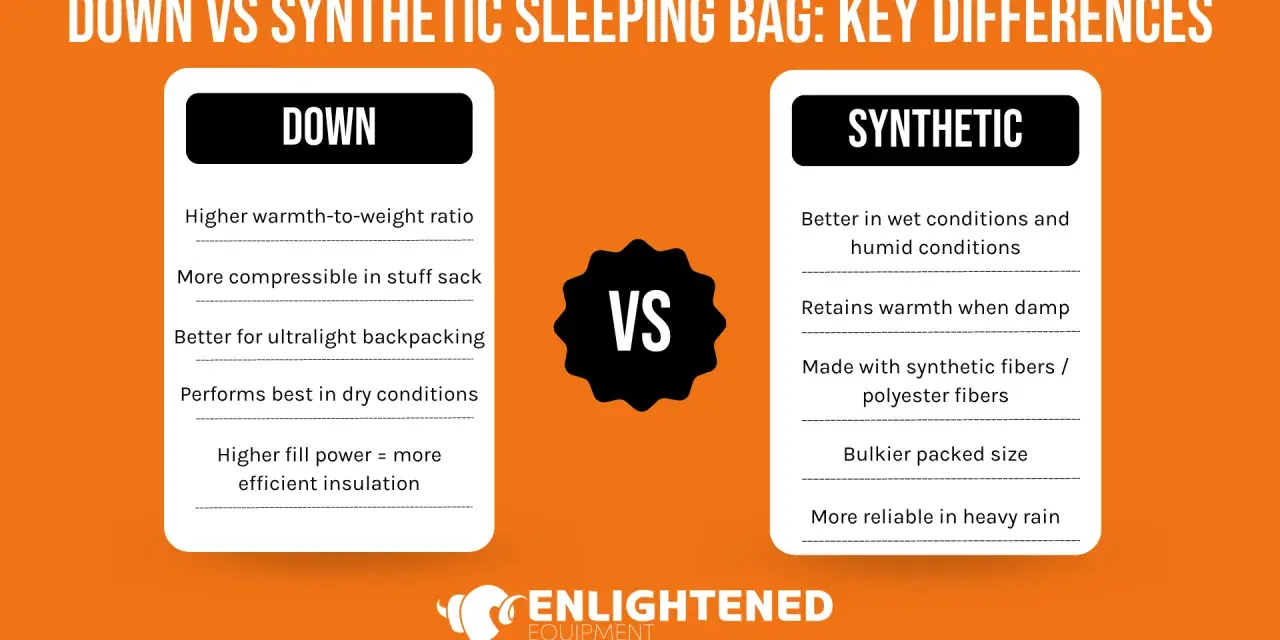
Choosing the right sleeping bag fill has a bigger impact on comfort than most people expect. Down gives you the best warmth-to-weight ratio and a smaller packed size, while synthetic insulation is more forgiving in damp weather, easier to dry, and usually kinder to the budget. The right answer depends on where you camp, how you travel, and how much wet-weather hassle you are willing to tolerate after a weekend under canvas.
The quickest way to choose the right fill
- Choose down if you want the lightest, most compact bag for backpacking or colder dry conditions.
- Choose synthetic if your trips often involve condensation, drizzle, wet grass, or a tent that stays damp for hours.
- A higher fill power down bag usually packs smaller for the same warmth; 700-fill is generally more efficient than 600-fill.
- Synthetic bags usually dry much faster - often around an hour or so, while down can take several hours.
- For UK and northern European camping, damp tolerance often matters more than shaving a few hundred grams.
The differences that actually matter
I ignore the marketing gloss and look at five things: weight, packed size, warmth-to-weight, moisture handling, and how much effort the bag needs after the trip. That is where the real split appears. Down lofts into a very efficient air-trapping layer, which is why it feels so warm for its weight. Synthetic fill is less efficient ounce for ounce, but it keeps working better when conditions are damp and is far less temperamental if the bag is used hard.
There is one more detail people often miss: the cut of the bag matters almost as much as the fill. A snug mummy bag will feel warmer than a roomy rectangular bag even if the insulation is identical, because there is less dead air to heat. If you compare only down with synthetic and ignore shape, temperature rating, and sleeping pad quality, you can end up choosing the wrong bag for the wrong reason.
| Factor | Down | Synthetic | What it means in practice |
|---|---|---|---|
| Weight | Lighter for the same warmth | Heavier | Down is usually better when every gram matters. |
| Packed size | Smaller | Bulkier | Down is easier to fit into a small rucksack or bikepacking setup. |
| Warmth-to-weight | Excellent | Good, but less efficient | Down wins when warmth and low carry weight are the priority. |
| Moisture handling | Good if treated, weaker when soaked | More forgiving in damp conditions | Synthetic is less likely to turn into a soggy, underperforming bag. |
| Drying time | Several hours | Often about an hour or a little more | Synthetic is easier after a wet trip or an accidental spill. |
| Cost | Usually higher | Usually lower | Synthetic is the easier entry point if you are buying for occasional camping. |
| Care | More delicate | Less fussy | Down rewards good storage and drying habits; synthetic is more forgiving. |
The short version is simple: down is a performance material, synthetic is a practical one. Neither is “better” on its own. The next question is where each one actually earns its place.
Where down earns its keep
Down is the smart choice when you want the highest warmth for the least carried weight. That is why I reach for it most often on backpacking trips, bikepacking routes, alpine camps, or any journey where the sleeping bag lives in a rucksack rather than the boot of a car. If you are covering real distance on foot, the lighter pack and smaller stuff sack matter every day, not just at bedtime.It also makes sense when you expect cold but mostly dry nights. A high-quality down bag can feel luxurious because it lofts well, compresses beautifully, and keeps performing in low temperatures without turning bulky. If you are comparing two bags with the same temperature rating, a higher fill power down version - for example 700-fill rather than 600-fill - usually gives you a better warmth-to-weight result.
What down does not forgive is neglect. If you cram it away wet, store it compressed for months, or camp in persistent damp without care, the advantage shrinks quickly. Treated or hydrophobic down helps, but it does not turn down into synthetic insulation. Once a down bag is properly soaked, it still needs time and airflow to recover.
That is the trade-off I keep in mind: down is outstanding when the environment is kind to it, but it asks for better judgement from the camper. That is why the wetter side of the decision matters so much.
Where synthetic insulation makes more sense
Synthetic fill is the more relaxed choice. It is the bag I would trust for family camping, school trips, festival weekends, wet shoulder seasons, and the kind of mixed weather that is common across the UK and much of northern Europe. If your tent walls collect condensation by morning, or if you often pack up after a damp night on grass, synthetic insulation removes a lot of stress from the equation.
It is also the better answer when the bag will be used hard and dried quickly. Think of children’s kit, guest bags, group camping, or caravanning, where packed size is less important than easy handling. Synthetic bags are generally bulkier, but in a car-based setup that is a very small penalty. The payoff is that they are easier to live with: they resist moisture better, dry faster, and usually cost less up front.
There is a comfort angle too. Many modern synthetic bags are far better than older ones at mimicking the feel of down, so the gap is not as dramatic as it used to be. They still do not compress as neatly, and they will usually weigh more for the same temperature rating, but for many campers that is a fair exchange for less worry and less maintenance.
For anyone who camps only a few times a year, synthetic often feels like the more sensible purchase because it behaves well even when the trip is not ideal. That brings the British weather into the picture, because it changes the balance more than most people expect.
How British and European weather changes the choice

If you mostly camp in summer and the forecast is steady, down can still be excellent. But once you move into spring, autumn, coastal sites, or hillier areas where the tent stays cold and damp for longer, synthetic starts to look more attractive. The bag may be heavier, but it is also less likely to lose its performance because the night air is wet or your shelter traps condensation.
For family camping, the practical rule is even simpler. If the sleeping bag may be stuffed into a boot after a drizzly pack-up, used by a child who spills a drink on it, or left slightly damp because the trip home is long, synthetic is the calmer choice. Down rewards better habits; synthetic tolerates ordinary camping life.
If you camp across Europe, the same logic applies. Dry alpine nights can favour down, while wetter coastal regions, forest camps, and shoulder-season trips often suit synthetic better. The climate around the trip matters more than the label on the bag.
How I would choose by trip type
I find it easier to decide by trip type than by brand claims or spec-sheet language. The bag should suit the kind of night you are most likely to have, not the ideal version of the trip.
| Trip type | Better choice | Why it fits |
|---|---|---|
| Weekend family camping | Synthetic | Bulk is less of a problem, and easy drying matters more than saving weight. |
| Long-distance backpacking | Down | Lower weight and smaller packed size make every mile easier. |
| Damp shoulder-season trips | Synthetic or treated down | Moisture resilience becomes the deciding factor. |
| Cold, dry mountain nights | Down | High warmth-to-weight is the main advantage. |
| Budget-conscious occasional camping | Synthetic | Lower purchase price and less delicate care make it easier to justify. |
| Bikepacking or minimalist travel | Down | Packed volume is usually as important as warmth. |
The interesting part is that the “best” option changes as soon as the trip changes. A bag that feels perfect for a dry mountain route can be a pain on a wet campsite, and a synthetic bag that is brilliant for the car park can be annoying on a multi-day walk. That is why care and real-life ownership costs matter just as much as the initial price.
Care, drying and the lifetime cost
The purchase price is only part of the cost. Down bags need more disciplined care: they should be stored uncompressed, dried thoroughly after use, and cleaned with a bit more caution. If you ignore that, the loft drops faster than the spec sheet suggests it should. Synthetic bags are less demanding, which is one reason they suit people who camp casually or who simply do not want one more gear item that needs special handling.
Drying time is the clearest everyday difference. Synthetic insulation usually dries much faster, which is a huge advantage after a wet weekend or a wash. Down can take several hours to dry properly, so you need more patience and a bit more space at home. If you are packing up on Sunday and the bag is still damp on Monday evening, that can become a mildew problem quickly.
There is also the question of what happens after repeated use. Good down can last a long time if you treat it well, and that longevity is part of why serious backpackers still pay for it. Synthetic usually loses a little performance sooner, but its lower upfront price and easier maintenance can make it the better value for anyone who is not camping often enough to justify premium fill.
My rule here is plain: if you want the bag to become a long-term piece of kit, buy quality and look after it properly. If you want a bag that just works without much attention, synthetic is the safer path.
The simplest way to choose before your next camp
If I had to reduce the whole decision to one rule, it would be this: choose down for dry, weight-conscious trips and choose synthetic for damp, low-fuss camping. That single line covers most real-world situations without pretending there is a universal winner.
- Pick down if you are carrying the bag a long way and the forecast is mostly dry.
- Pick synthetic if your nights are often humid, wet, or unpredictable.
- Pick synthetic for family use when convenience matters more than compact packing.
- Pick down if you want the best possible warmth in the smallest possible package.
- If you are still torn, buy the bag that matches the weather you actually face most often, not the trip you hope to take once a year.
For most British campers, that usually means synthetic is the easier everyday choice, while down remains the better specialist option for lighter packs and drier conditions. If I were packing for a wet family weekend on a campsite, I would take synthetic without hesitation. If I were heading out on a longer trek with a stable forecast and every gram mattered, I would pay extra for down and enjoy the smaller, lighter load.
