
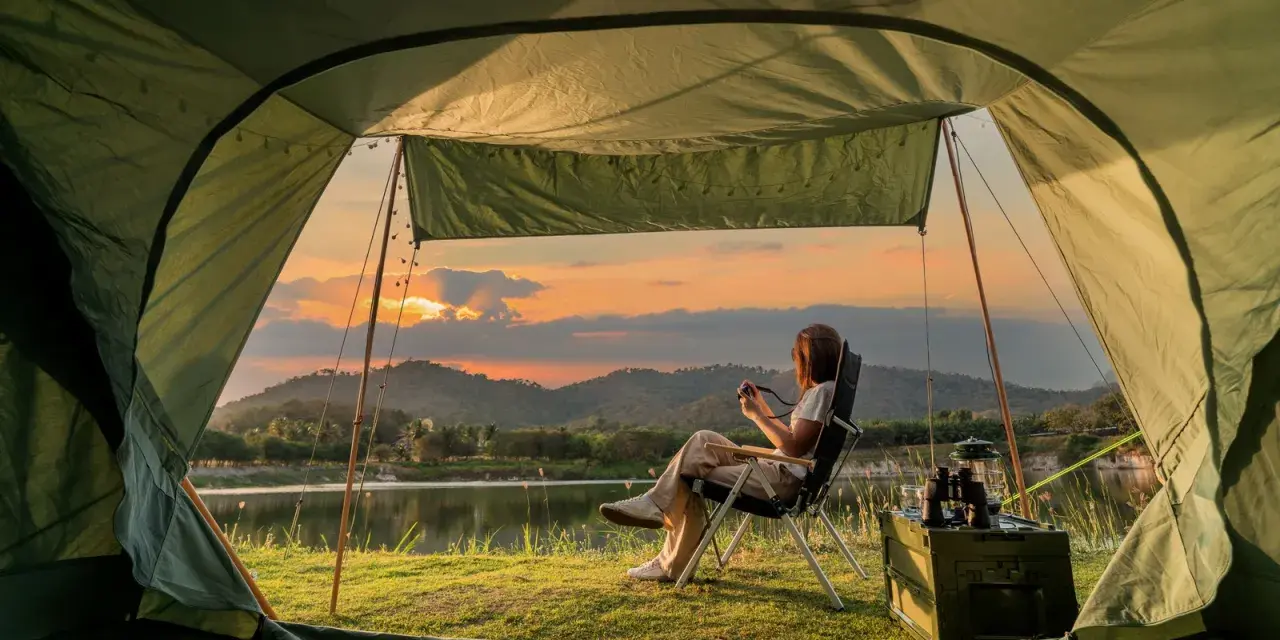
Solo camping can be one of the most rewarding ways to spend a night outdoors, but it only feels good when the basics are calm, simple, and reliable. In this guide, I focus on the practical side of camping alone in the UK: how to choose the right place, what to pack, how to stay safe, and how to make the first trip feel manageable rather than exposed.
The main thing is to make the first night simple
- Start on a staffed campsite before you move into more remote conditions.
- Pack for wind, damp, and a colder night than the forecast suggests.
- Tell someone your plan, your return time, and your backup option.
- Set up in daylight so you are not troubleshooting in the dark.
- Keep navigation, light, and power within easy reach.

Choose the right kind of night outdoors
The best place to start is not the wildest one. For a first night on your own, I prefer a staffed campsite because it removes the legal guesswork, gives you water and toilets, and keeps other people nearby if something feels off. In current UK listings, basic tent pitches can start around £12 to £15, while many busier or more serviced sites sit closer to £20 to £40 depending on season, location, and facilities.
| Option | Best for | Main trade-off | My view |
|---|---|---|---|
| Staffed campsite | First trips, easy logistics, building confidence | Less solitude | The safest starting point |
| Permitted backpack camping | Lightweight trips with a walk-in approach | More planning, less comfort | Good once your setup is automatic |
| Responsible wild camping in Scotland | Quiet, low-impact nights in open country | No facilities and more weather exposure | Worth it if you already trust your navigation and kit |
VisitScotland describes wild camping in Scotland as lightweight, low-impact camping on unenclosed land, usually for one or two nights. That is a useful rule of thumb because it keeps the experience responsible and realistic rather than romanticised.
For England and Wales, I treat camping as permission-required unless the site or landowner clearly says otherwise. That approach saves a lot of confusion, and it keeps the focus on the actual trip instead of on whether you are standing in the right place. Once the location is sorted, the next question is whether your kit supports the night you want to have.
Pack light, but do not pack thinly
When I pack for a night on my own, I aim for a simple rule: every item should solve a real problem, not just make the bag feel complete. The most useful kit is usually boring, and that is exactly what you want.
| Item | Why it matters | What I watch for |
|---|---|---|
| Tent or shelter | It is your weather system, privacy, and sleep space | Fast setup, solid pegs, and enough room to move without dragging gear everywhere |
| Sleeping bag or quilt | Warmth is what keeps a quiet night pleasant | For spring and autumn in Britain, I prefer a comfort rating around 0C to 5C |
| Sleeping mat | Insulation from cold ground matters as much as the bag itself | Pick enough thickness that your hips and shoulders do not hit the ground |
| Headtorch | You need both hands free at dusk and inside the tent | Bring spare batteries or a charged backup |
| Power bank | Phones drain fast when you use maps, photos, and torch mode | A 10,000 mAh pack is a sensible floor for a one-night trip; mAh is the battery capacity measure |
| Navigation | Offline maps prevent small mistakes from becoming big ones | Do not rely on mobile signal or a single app |
| Food and water | Low-energy campers make poor decisions | Keep one extra snack and more water than you think you need |
| Dry clothing | Wet socks and cold layers ruin morale quickly | Carry at least one full spare layer set in a dry bag |
I also keep a tiny comfort layer in the pack: tea, a book, earplugs, and a spare pair of socks. That sounds minor, but it is often the difference between “I tried this once” and “I want to do it again.” With the kit sorted, the trip becomes less about guesswork and more about routine.
Build a safety routine before you zip the tent
When you are camping alone, safety is mostly about removing avoidable surprises. I do not rely on confidence or instinct here; I rely on a repeatable routine that I run before I leave home.
- Tell one person exactly where you are going, what time you expect to arrive, and when you will check in again.
- Check the forecast twice, especially if you are heading into hills or exposed ground. I use the Met Office mountain forecast the evening before and again on the morning of departure because UK conditions can change quickly.
- Download offline maps and mark the nearest road access, exit route, and any water source you plan to use.
- Arrive early enough to pitch in daylight.
- Put your torch, water, jacket, boots, and phone somewhere you can reach them without leaving the tent.
- Have a stop rule. If the wind is stronger than expected, the ground is soaked, or you are arriving too late to set up cleanly, use the campsite instead of forcing the plan.
I also watch for cold-related problems. A body temperature below 35C is hypothermia, and it is a medical emergency. Shivering, confusion, slow speech, and clumsiness are not things to “push through”; they are signs to get dry, get warm, and get help if the symptoms are serious. If you ever feel genuinely unsafe, call 999 or 112 and ask for help. Good camping starts with knowing when to stop pretending everything is fine. That is why the first trip should be deliberately easy to manage.
Plan the first trip like a rehearsal
I get the best results when the first solo night is treated as a rehearsal, not an achievement. The goal is to practice the boring parts: pitching, cooking, sleeping, packing down, and waking up without stress.
- Keep the drive short, ideally within 60 to 90 minutes of home.
- Book one night only.
- Arrive with enough daylight left to set up slowly.
- Choose a meal you can cook without improvising.
- Leave one easy comfort item in the car or pack, such as a camp chair or a proper mug.
- Have a clear fallback option if the site feels wrong when you arrive.
That approach sounds almost too cautious, but it works. A first trip that feels ordinary builds far more confidence than one that feels heroic. The point is to go home thinking, “I know how to do this now,” not “I survived this somehow.” Once that pattern is in place, the common mistakes become much easier to spot.
The mistakes I see most often on first solo trips
Most problems on a one-person trip come from trying to do too much too soon. I see the same errors repeat because they are tempting, not because they are complicated.
- Going too remote too early. Beautiful, yes; practical, often no. A remote pitch gives you less margin when weather turns or nerves kick in.
- Underestimating moisture. In the UK, damp ground, condensation, and wind chill matter more often than bright daytime temperatures suggest.
- Bringing a kitchen fit for a weekend with friends. Simple food wins. One pan, one spoon, one meal you already know how to cook is usually enough.
- Depending on one device. A phone is useful, but I always want a backup light source, offline maps, and enough battery to make a call if needed.
- Arriving late. Setting up in the dark creates tiny mistakes that become annoying fast.
- Ignoring local rules. If the area has specific access restrictions, I read them before I leave, not after I unpack.
There is also a mental mistake: treating solo camping like a test of toughness. It is not. It is a test of planning. Once you see it that way, the pressure drops and the trip gets better.
The habits that make the next trip easier
After the first few nights, I keep a small system so each new trip is easier than the last. The less I have to think about the basics, the more I can enjoy the quiet.
- Keep a permanent checklist on your phone or in a notebook.
- After every trip, note three items you used, three you did not, and one thing you would change next time.
- Repack essentials the same day you get home, especially the torch, charger, stove fuel, and dry socks.
- Keep a ready-to-go box in the car with bin bags, a microfibre towel, snacks, tissues, and a paper map.
- Upgrade one thing at a time, not everything at once.
The best nights outdoors are usually the ones that feel unforced. When you choose a sensible site, pack for British weather, and build a simple safety routine, camping alone stops feeling like a gamble and starts feeling like a skill you can rely on.
