
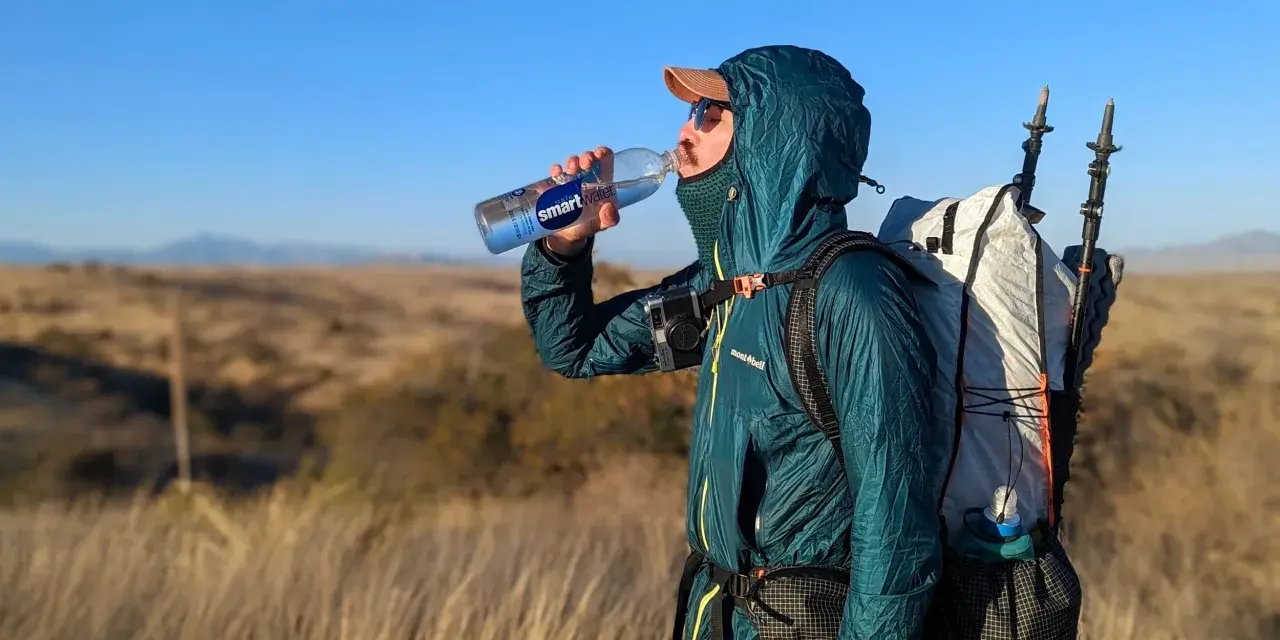
On British hills, the water plan often matters more than the gear list. The practical challenge of carrying water on the trail is balancing access, weight, and refill points so you actually drink enough without turning your pack into dead weight. In this guide I focus on the decisions that matter in hiking and backpacking: how much to bring, which container works best, when to treat water, and how to keep the whole setup comfortable on the move.
The simplest water plan is the one you can keep using
- Start with the longest dry stretch on your route, not a random litre target.
- Every extra litre adds about 1 kilogram, so overpacking water has a real cost.
- Bottles are easiest to monitor; bladders are best when you want to sip without stopping.
- For many UK hill walks, 1.5 to 2 litres is a sensible starting point, then adjust for heat and exposure.
- Any natural refill that is not clearly safe should be treated before you drink it.
- One accessible bottle is usually better than two buried deep in the pack.
Start with the route, not the bottle
I usually build a water plan from the map outward. The real question is not how much water looks reasonable in the abstract, but how long I will be without a reliable refill and how hard the route is likely to feel in that section.
That means I look at four things before I leave:
- Distance to the next reliable source - a stream, tap, bothy, campsite, or village shop.
- Exposure - wind, sun, and open ridges increase fluid loss faster than sheltered woodland paths.
- Effort level - a steep ascent on a warm day demands more than a flat canal towpath.
- Who is with me - children, dogs, and slower walkers change the amount you need to have on hand.
For backpacking, I also think about camp. If I need to cook, hydrate properly after a long day, and still have enough for the morning, I need a buffer that is bigger than the amount I would carry on a simple day walk. Once that dry stretch is clear, the container choice becomes much easier.

Which container suits the route
For most walks, the best container is the one that makes drinking easy. I like simple systems because they are easier to monitor and less likely to fail when I am tired, cold, or distracted by the scenery.
| Container | Best for | Strengths | Trade-offs |
|---|---|---|---|
| Hard bottle | Day hikes, family walks, simple refill plans | Easy to see how much is left, durable, simple to share | Needs a hand to drink, slower on steep climbs |
| Hydration bladder | Long climbs, hot days, backpacking | Lets you sip while moving, keeps water weight close to the back | Harder to track remaining volume, cleaning takes more effort, hose can freeze in winter |
| Soft flask | Light day kits, fast movement, chest pockets | Compresses as you drink, light, easy to stow | Smaller capacity, not ideal as your only supply |
| Collapsible bottle | Backup water, camp use, spare capacity | Packs flat when empty, useful on multi-day trips | Less convenient while walking, not as solid as a hard bottle |
My default for most UK day walks is a 1 litre bottle in a side pocket plus a smaller backup flask if the route is warm or remote. A bladder makes more sense when the day includes long climbs, because small sips are easier than stopping every 20 minutes. If I am walking with children, I prefer each person to have their own bottle; it is simpler, safer, and avoids one adult becoming the unofficial water station.
Once you know what you are carrying, the next question is how much you actually need.
How much to take on a day hike or overnight trip
The National Trust suggests about two litres of water per adult for a hill walk, and REI uses roughly 500 ml per hour in moderate conditions as a practical starting point. I treat both figures as a baseline, not a rule, because heat, sweat rate, climb, and route length can change the answer quickly.
| Situation | Practical starting amount | Why this usually works |
|---|---|---|
| Short cool walk | 500 ml to 1 litre | Enough for a few hours if you start hydrated and finish near a refill point |
| Half-day hike | 1 to 1.5 litres | Covers steady effort without forcing you to carry a heavy load |
| Full-day hill walk | Around 2 litres | A sensible all-round starting point for many UK routes |
| Hot, exposed, or very steep day | 2 to 3 litres or more | Heat, sun, and long climbs can push demand up fast |
| Overnight backpacking with a source near camp | 1 to 2 litres while walking, then top up at camp | Keeps the moving load manageable while still leaving enough for cooking and the evening |
That weight matters more than people expect. One litre of water weighs about 1 kilogram, so an extra 2 litres is not just a bit more volume, it is 2 kilograms before the bottle itself. On steep ground, that changes the whole feel of the day.
For backpacking, I would rather carry enough to get between sources and refill on arrival than start every day with a full, heavy load. On family outings, I also keep in mind that children usually need smaller amounts at a time, but more frequent reminders to drink.
If you still need to collect water en route, the next issue is making sure it is safe.
Treat refills as part of the plan
In the UK hills, a clear stream is not automatically a clean stream. Grazing land, upstream settlements, path crossings, and heavy rain can all affect what is in the water, even when it looks cold and fresh. I treat any uncertain source as a decision, not a convenience.
| Method | Best use | Strengths | Limits |
|---|---|---|---|
| Filter | Regular refills from streams, tarns, and springs | Fast, reusable, good for routine backpacking | Can clog, needs cleaning, does not solve every contamination issue |
| Tablets | Ultralight backup or emergency use | Tiny, simple, inexpensive | Needs contact time, can affect taste, slower when you are thirsty |
| Boiling | Camp use or the most uncertain sources | Very reliable against biological contamination | Uses fuel and time, so it is less convenient on the move |
For most backpacking trips, I like a filter as the main tool and tablets as the backup. That combination gives me speed and insurance. If the water is cloudy, smells odd, or comes from a low, busy area, I get stricter rather than more optimistic.
Official taps and campsite supply points are easy decisions. Natural sources are the ones that deserve more caution, especially after rain or when livestock have been close by. Once the water is safe, the last challenge is making sure you can actually drink it when you need it.
Pack it where you can reach it
If water lives at the bottom of your pack, you will drink less than you should. I want at least one bottle where I can reach it without stopping, and I want the heaviest water kept close to my back so it does not swing around or pull me off balance.
- Keep one bottle in a side pocket or shoulder pocket for fast access.
- Use a bladder when steady sipping matters more than seeing the level at a glance.
- Keep one bottle reserved for camp so cooking does not empty your walking supply.
- In winter, store bottles inside the pack or insulate them so they do not freeze as quickly.
- Do not bury all your water under spare clothing and food.
That last point sounds obvious, but it is one of the main reasons people underdrink on longer hill days. If getting to the bottle is annoying, most walkers simply wait too long. The easier the access, the more naturally you sip.
Good placement also helps with weight management. A litre at the top of the pack feels very different from a litre close to the spine, and the difference is obvious once the route starts climbing.
The mistakes that make people run dry
The biggest problems are usually not dramatic. They are small planning errors that compound over several hours.
- Planning from the straight line on the map - detours, mud, and ascent add time, and time adds thirst.
- Taking only one container - if it leaks, freezes, or falls over, your plan falls apart with it.
- Waiting until you feel thirsty - by then, performance is already starting to dip.
- Ignoring food and electrolytes on hot days - plain water helps, but it is not always the whole answer when you have been sweating for hours.
- Skipping a treatment backup - a broken filter or an empty tablet packet can turn a good route into a difficult one.
The other common mistake is over-carrying. On routes with reliable taps, cafés, streams, or campsite water, hauling far more than you need just means you are paying for it in weight. I would rather carry a little less and stay flexible than start the day already tired from the water load.
That balance is what makes the difference between a route that feels efficient and one that feels unnecessarily hard.
A water routine that works on most UK routes
My default on a normal UK day hike is simple: check the longest dry stretch, start with 1.5 to 2 litres if the route is ordinary, and move toward 2 to 3 litres on hot or exposed days. If the route has reliable taps or clear refill points, I carry less at the start and top up as I go; if it is remote, I build in a larger buffer and a treatment backup.
- One accessible bottle beats one hidden bottle.
- One backup treatment method beats hopeful thinking.
- One bottle per child or dog beats one adult trying to manage everything.
The right setup is not the lightest one on paper; it is the one that keeps you drinking steadily and still feels manageable on the steep parts. Once that balance is right, the rest of the walk gets easier to enjoy.
