
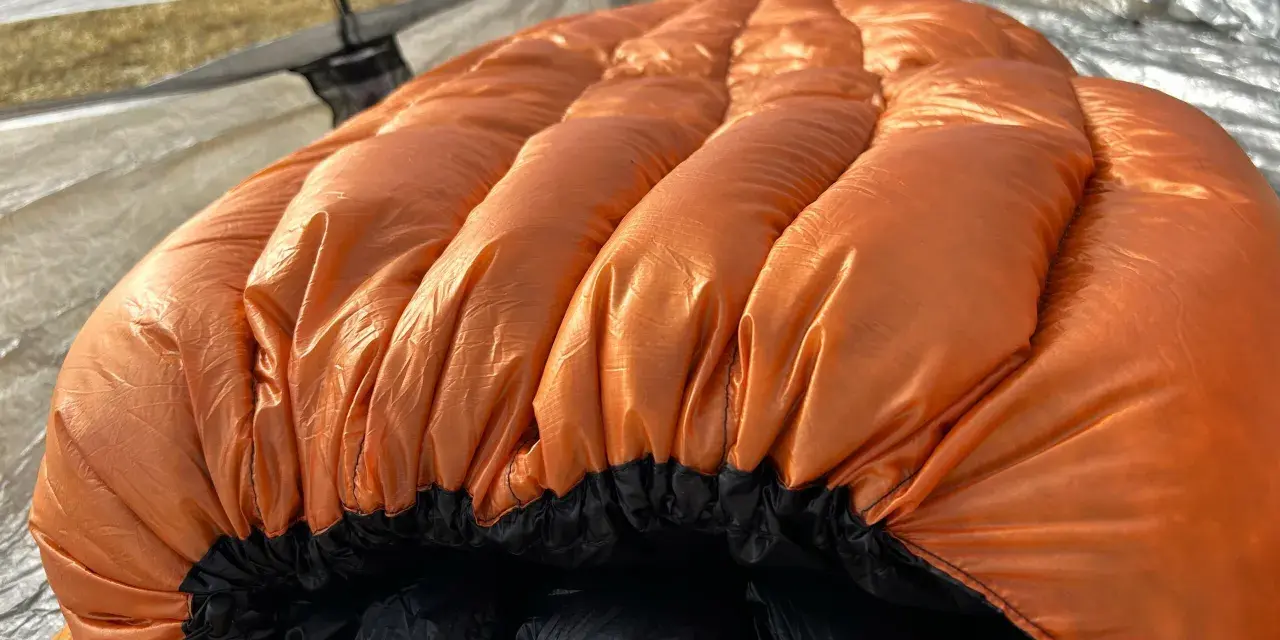
A 20°F sleeping bag sits in a useful middle ground: light enough for serious backpacking, warm enough for cold shoulder-season nights, and still compact enough to live happily in a small pack. With Zpacks, the real story is not just the temperature number, but how the down fill, cut, zipper design, and sleep-system setup work together when the weather turns damp and windy.
Quick facts before you buy
- The 20°F / -7°C version is best treated as a strong three-season bag, not a guaranteed winter solution for exposed UK camps.
- Zpacks uses 950FP Muscovy duck down, with 30% extra fill in each compartment for loft retention.
- The Classic model weighs from 16.5 oz to 21.0 oz depending on size, with a packed size as small as 6" x 12".
- The bag uses a 3/4 length zipper, which keeps weight down and makes venting easier on milder nights.
- A roll-top dry bag is included, which is a genuinely useful detail for UK camping where moisture management matters.
- Zpacks notes that its bags are not ISO-tested, so I treat the rating as a practical guide rather than a hard guarantee.
What the 20°F rating means on a real trip
On paper, 20°F means about -7°C, but that number only makes sense if you read it as a starting point rather than a promise. Zpacks says its bags are not ISO-tested and are estimated to sit closest to the ISO transition range, which tells me to think in real-world terms: shelter quality, pad warmth, wind exposure, and what I wear to bed matter just as much as the bag itself.
For UK use, I would place this bag squarely in the cold shoulder-season category. It makes sense for an April night in the Lake District, an autumn camp in the Scottish Highlands, or a chilly family pitch where the temperature drops faster than expected. It is not the bag I would choose for exposed winter bivvies and I would not rely on it alone on a frosty, windy night if my sleeping pad and clothing were mediocre.
That is the main buying takeaway: the 20°F version is the all-rounder in the Zpacks line, but it still wants a proper sleep system around it. That leads straight into the actual construction, because the materials are doing a lot of the work here.
What Zpacks actually builds into the Classic
The Classic model is not just a light shell with down stuffed inside. Zpacks builds it around 950 fill power Muscovy duck down, overfills each compartment by 30%, and uses vertical baffles on the upper body to keep the insulation where it belongs. In practice, that means less shifting, fewer cold spots, and a better chance that the bag keeps its loft after repeated compression.
| Feature | Why it matters |
|---|---|
| 950FP Muscovy duck down | Very high warmth-to-weight efficiency, which is the whole point of ultralight insulation. |
| 30% extra down fill | Helps maintain loft over time and gives the bag a little more resilience after hard use. |
| Vertical upper baffles | Reduce down migration and help the top of the bag stay consistently warm. |
| No sewn-through seams | Lowers the risk of thin lines where heat escapes. |
| PFAS-free C0 DWR shell and liner | Offers resistance to spray and body moisture without leaning on older chemical treatments. |
| Included roll-top dry bag | Useful for keeping the bag protected in a damp pack or during transport. |
That design only works well if the fit is right, though, and that is where many buyers make their first mistake. A warm bag that fits badly is still a bad bag.
Which size and cut makes sense for your body
Zpacks gives you three body widths and several lengths, and the right choice is mostly about balancing warmth against comfort. My rule is simple: choose the narrowest cut that still lets you sleep naturally. Too much dead air warms slowly, while a cut that is too tight can compress the down and make the bag feel restrictive.
| Cut | Best for | Trade-off |
|---|---|---|
| Slim | Minimalists, narrower frames, and people who sleep still | Lowest weight, but least room for thick layers |
| Standard | Most campers | Best balance of comfort, warmth, and weight |
| Broad | Side sleepers, restless sleepers, and anyone who wants winter layering room | More weight and a slightly larger packed volume |
Length matters too. The short version fits up to 5'6" / 168 cm, the medium up to 6'0" / 188 cm, and the long up to 6'6" / 198 cm. If you are between sizes, I would think about how you actually sleep, not just your height. A colder sleeper who moves a lot often benefits more from a slightly roomier cut than from shaving off a few grams.
If I were choosing for myself without a fitting session, I would start with the Standard-Medium. It is the safest default for most adults, and it avoids the common mistake of buying an ultralight bag that is technically warm enough but awkward in practice. Once the fit is set, the next question is how the bag handles the weather you will actually face.

How it behaves in UK weather
British camping is a moisture management game as much as a temperature game. Even a good down bag can underperform if the tent is wet, condensation is heavy, or the sleeping pad is weak. The good news is that Zpacks has made a few sensible choices here: the shell and liner use a PFAS-free DWR finish, the down is ultrasonic-washed, and the bag ships with a dry bag. None of that makes it waterproof, but it does make the system more realistic for the UK.
In actual use, I would treat this bag as a strong option for:
- cool spring weekends when the forecast is uncertain
- autumn camps where the night temperature drops faster than expected
- mountain or exposed sites where wind makes the air feel colder than the forecast suggests
- family trips in colder weather, where one dependable bag is easier than building around a marginal summer bag
Where it becomes less attractive is when the trip is mostly mild, low-altitude, and dry. For a warm July night in southern England, the 20°F bag can be more warmth than you need. On the other hand, for a wet and windy night in the hills, I would rather have extra insulation than wake up trying to improvise warmth.
That balance is why the 20°F version is interesting, but it is not the only Zpacks sleeping bag worth comparing.
How it compares with the other Zpacks options
Zpacks currently offers three 20°F formats, and the difference is less about temperature than about shape and convenience. I would read them like this: the Classic is the lightest all-round balance, the Zip Around is the most flexible, and the Mummy is the most traditional cocoon-style option.
| Model | Design | Listed weight | Listed price | Best for |
|---|---|---|---|---|
| Classic Sleeping Bag | 3/4 zipper, quilt-bag hybrid feel | 16.5 oz to 21.0 oz | $419 | Best overall balance of warmth, weight, and versatility |
| Zip Around Sleeping Bag | Full-length wrap-around side zipper with draft tube | 15.7 oz | $499 | Best if you want maximum venting and blanket-like use |
| Mummy Sleeping Bag | Traditional mummy shape | 22 oz | $579 | Best if you prefer a more enclosed, classic sleeping-bag feel |
My take is straightforward: if you want the best mix of low weight and practical warmth, the Classic is the one I would start with. If you often overheat, sleep hot, or like the ability to fully unzip and vent, the Zip Around starts to look more appealing. If you just prefer a more conventional mummy bag and do not mind the extra weight, the Mummy makes sense. That comparison matters because the bag is only one half of the decision; what you pair it with matters just as much.
What I would pair it with before trusting it on a cold night
If I were building a sleep system around this bag, I would make four things non-negotiable: a warm sleeping pad, dry base layers, a shelter with decent ventilation, and a plan for moisture control. The bag can do its job only if the ground and the air around it are not stealing heat back out of the system.
- Use a properly warm pad rather than a summer mat that looks light but performs badly once the temperature drops.
- Keep your sleep clothing dry, because damp base layers can undo a lot of the bag’s insulation advantage.
- Vent the shelter whenever condensation builds, especially in humid UK conditions.
- Store the bag carefully, because down loses performance fastest when it is packed wet or left compressed for too long.
If you sleep cold, I would also be honest about the temperature rating and move up to the 10°F version instead of trying to compensate with extra layers. The opposite is also true: if most of your trips are milder lowland camps, the 30°F version may be the better weight-saving choice. Choosing the right rating is less about ego and more about matching the bag to the nights you actually sleep on.
The call I would make for most UK campers
For most campers in the UK, I see the 20°F Classic as the sweet spot in the Zpacks line. It is warm enough for shoulder-season weather, light enough to carry without resentment, and versatile enough to handle the occasional warmer night without becoming unbearable. The 3/4 zipper, 950FP down, and compact packed size make sense for anyone who values performance per gram.
If your trips are mostly summer lowlands, I would step down to the 30°F model. If you run cold, camp high, or head out when frost is a real possibility, I would move up to the 10°F option. The 20°F bag is the middle lane, and that is exactly why it works so well: it gives you a realistic margin for the unpredictable weather that defines a lot of European camping.
For me, the deciding factor is not whether the bag is “good enough” on paper, but whether it matches the nights you really sleep outside. On that measure, the 20°F Zpacks Classic is a strong, well-judged piece of outdoor gear for UK shoulder seasons and colder three-season trips.
