
A carabiner is one of the simplest pieces of outdoor gear, but it solves a very specific problem: joining gear quickly, securely, and repeatedly without fuss. In camping, that might mean hanging a lantern, clipping a stuff sack, or tidying a tent line; in climbing, it becomes part of a safety system where the wrong choice matters. I want to separate those uses clearly, because the shape, gate, and rating all change what the connector can safely do.
The short version is that a carabiner is a spring-loaded connector, but the right one depends on the job
- Definition: a metal connector with a spring-loaded gate that opens and closes quickly.
- Camping use: best for clipping, organising, and hanging lightweight kit around camp.
- Safety use: only rely on a properly rated connector for climbing, fall protection, or any load-bearing task.
- Shape matters: D-shaped, oval, and pear-shaped carabiners behave differently under load.
- Locking matters: non-locking models are faster; locking models give more security.
- Buying rule: check the markings, not just the look of the clip.

What a carabiner actually is
At its core, a carabiner is a metal connector with a spring-loaded gate on one side and a solid spine on the other. The gate opens to let in rope, webbing, or hardware, then closes automatically, which makes the tool fast to use and easy to repeat. That is the basic idea behind every version, from a tiny accessory clip on a daypack to a load-rated connector used in climbing.
The parts are worth knowing because they explain how the connector behaves. The gate is the moving arm, the spine is the stronger curved side, and the nose is the tip where the gate meets the body. In practical terms, the spine should take the load, the gate should stay shut, and the nose should not snag on ropes or webbing.
That distinction matters in outdoor gear. In a campsite, a carabiner is usually a convenience tool. In climbing or rescue work, it is part of a system that must stay closed and loaded in the right direction. Once you understand that split, the rest of the topic becomes much easier to judge. The next step is looking at the shapes and locking systems that change how the connector behaves.
The main shapes and locking styles
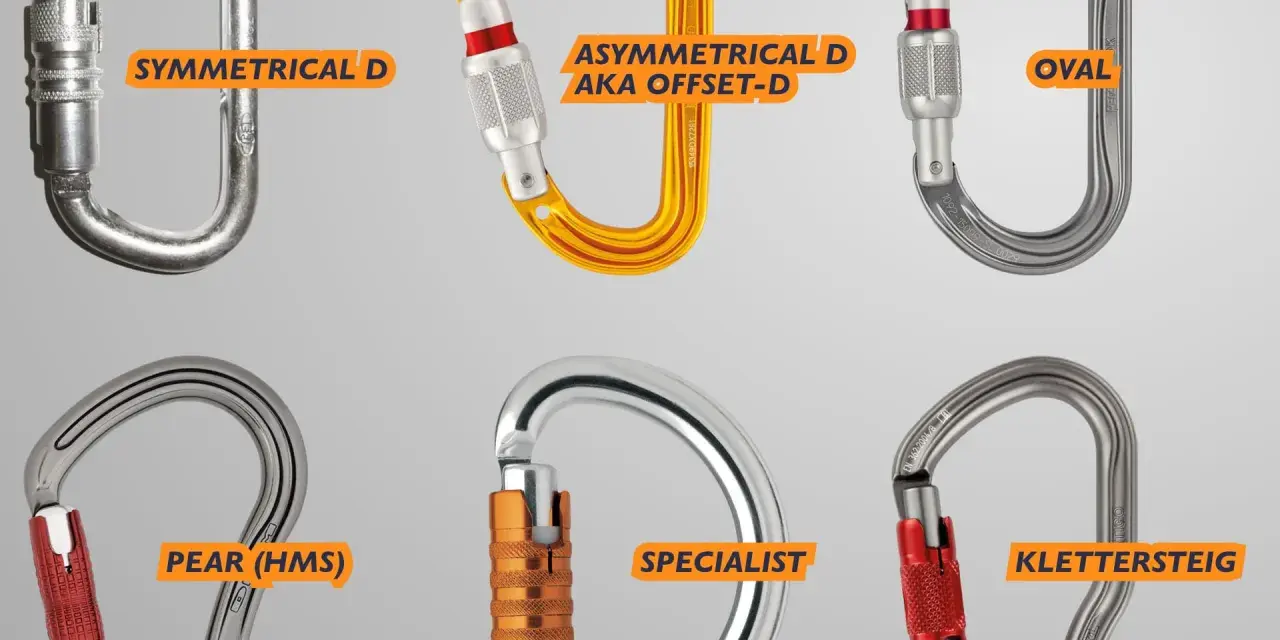
Shape changes how force sits in the connector, while the gate system changes how securely it stays shut. Two carabiners can look similar at a glance and still be built for very different jobs, which is why I never buy one purely on appearance.
Common shapes
| Shape | Best for | Why it works | Trade-off |
|---|---|---|---|
| D-shaped | General outdoor use and many climbing tasks | Directs more of the load to the spine | Less internal space than a pear-shaped design |
| Oval | Pulleys, rescue hardware, and keeping items centred | Symmetrical shape helps hardware sit neatly in the middle | Not as efficient for one-direction loading as a D-shape |
| Pear or HMS | Belay devices, bulky knots, or multiple attachments | Large basket gives more room inside the connector | Usually bigger and heavier |
| Wiregate or lightweight accessory clip | Fast clipping, pack organisation, or quickdraw-style use | Lighter and often less prone to gate flutter | Not a replacement for a rated locking connector |
The D-shape is the workhorse. Oval models are more specialised but very neat when you need centred hardware. Pear-shaped carabiners, sometimes called HMS shapes, are the roomy option that makes belay devices and bulky knots easier to manage. For camping, the shape matters less than whether the connector is comfortable to use with cold hands and whether it closes cleanly every time.
Read Also: Break In Hiking Boots Safely - Avoid Blisters Now
Locking systems
| Locking style | How it works | Best use | Trade-off |
|---|---|---|---|
| Screwgate | A threaded sleeve is tightened by hand over the gate | Simple, reliable security for many outdoor and climbing tasks | Slower to open and close |
| Auto-locking | The gate locks automatically when it closes | Frequent clipping where extra security is useful | More mechanical complexity |
| Non-locking | The gate opens with a simple press and closes by spring tension | Light, quick, low-risk clipping and gear organisation | Can open accidentally if used in the wrong place |
If I am packing for a family campsite, I usually want at least one lightweight non-locking clip for low-stakes jobs and one locking model for anything I do not want popping open. That small difference changes how much confidence I have in the connection, which is why the next topic is not optional: strength ratings and markings.
How ratings and markings should be read
For load-bearing use, the numbers and symbols on the carabiner matter more than the branding. On proper outdoor connectors, you will often see a rating in kN, which stands for kilonewtons and is a force unit. You may also see standards such as EN 12275 for mountaineering connectors or EN 362 for personal fall-protection connectors. If those markings are missing, I would treat the item as convenience hardware, not safety gear.
| Marking or term | What it means | Why it matters |
|---|---|---|
| kN | A force rating printed on the connector | Shows how much load the connector is designed to handle in test conditions |
| Major axis | The strongest direction, along the spine | This is the number most people should check first |
| Minor axis | Side loading across the gate | Usually much weaker than the major-axis rating |
| Gate open rating | The connector with the gate open or partially compromised | Explains why an open gate is a real hazard, not a minor detail |
| EN 12275 or EN 362 | European standards for rated connectors | Indicates the connector is meant for load-bearing or safety use |
The most common mistake is assuming that any metal clip with a spring gate is automatically strong enough for climbing. It is not. A keyring clip, a bargain accessory hook, and a certified connector may look similar from a distance, but they are not built or tested for the same job. Once you understand the markings, it becomes much easier to use one safely in real outdoor situations. That is where the practical side of camping and hill use comes in.
How to use one safely in the field
For camping, a carabiner is best treated as a quick connector for low-risk tasks. I use them for hanging a lantern inside a tent shelter, clipping a water bottle to a pack, keeping cooking tools together, or organising small accessories so they do not disappear into the grass. Those are exactly the kind of jobs where a clip saves time and makes camp feel tidier.
There are also clear limits. A carabiner is not a substitute for a proper anchor, a knot, or a load-rated suspension system. If the result of failure could be injury, the connector needs to be specifically rated for that use. I would never trust a non-rated clip for climbing, belaying, hauling people, or hanging a hammock.
- Good campsite uses: lanterns, mugs, head torches, stuff sacks, guy lines, and general organisation.
- Borderline uses: light pack clipping, provided the load is small and a failure would only be inconvenient.
- Bad uses: climbing, belaying, suspension, towing, or anything where a sudden release could hurt someone.
When I clip gear around a tent or pack, I also check that the load is sitting on the spine rather than forcing the gate against a surface. That one habit prevents a lot of avoidable mistakes, and it leads directly into how I would choose the right connector for a camping kit.
How I would choose one for camping gear
If the goal is camping rather than climbing, my buying logic is simple: choose the lightest connector that still matches the risk. For a family campsite in the UK or elsewhere in Europe, aluminium usually makes more sense than steel because it keeps the kit lighter and easier to carry. Steel is tougher and more wear-resistant, but it is noticeably heavier, so I reserve it for harsher or more fixed-use situations.
| Use case | What I would choose | Why |
|---|---|---|
| Lantern, cup, or small accessory on a campsite | Lightweight aluminium non-locking clip | Fast, light, and perfectly adequate for convenience tasks |
| Something that should stay closed all day | Screwgate locking connector | Simple security without much complexity |
| Bulky knots or multiple attachments | Pear-shaped or HMS locking connector | More internal space and easier handling |
| Pulley or centred hardware | Oval locking connector | Keeps gear aligned and tidy |
| Harsh, fixed, or work-style use | Steel connector with the proper rating | Better durability when abrasion is a bigger issue than pack weight |
I tend to choose the shape last and the rating first. That sounds dull, but it is the right order. A beautifully shaped carabiner that is not suited to the load is still the wrong tool, and that is the point a lot of beginners miss. The mistakes are common enough that they deserve their own section.
Common mistakes that cause trouble
The biggest error is buying a clip that looks technical and assuming it is automatically safety-rated. That is where people get caught out. The second mistake is using the right connector in the wrong way, especially by loading it across the gate or letting the gate press against rock, metal, or another piece of hardware.
- Confusing accessory clips with rated connectors: if there is no clear marking, do not use it as life-support gear.
- Ignoring cross-loading: a sideways load can drastically reduce how much force the connector can handle.
- Choosing the wrong shape for the job: an oval is not automatically better than a D-shape, and a pear shape is not always the most practical.
- Leaving the gate exposed to pressure: a gate can be forced open by contact with a hard surface or another connector.
- Buying only on price: the cheapest option is often the least comfortable, least durable, or least clearly marked.
My rule is simple: if a carabiner is going anywhere near a safety system, I want a clearly marked, properly rated connector from a trusted outdoor manufacturer. If it is only organising camp kit, I still want decent build quality, but I care more about ease of use, weight, and the gate action. That distinction keeps the gear useful instead of just looking the part.
A small connector that earns its place in a kit
The practical answer is that a carabiner is a fast connector, not a universal fix. Used well, it makes outdoor life easier by turning loose items into tidy, accessible kit. Used carelessly, it creates false confidence, which is much worse than having no clip at all.
For camping, I would keep one lightweight non-locking clip for everyday convenience and one properly rated locking connector for anything that must stay secure. That combination covers most real-world jobs without adding unnecessary weight or complexity, and it is usually all a family outdoor kit needs.
