
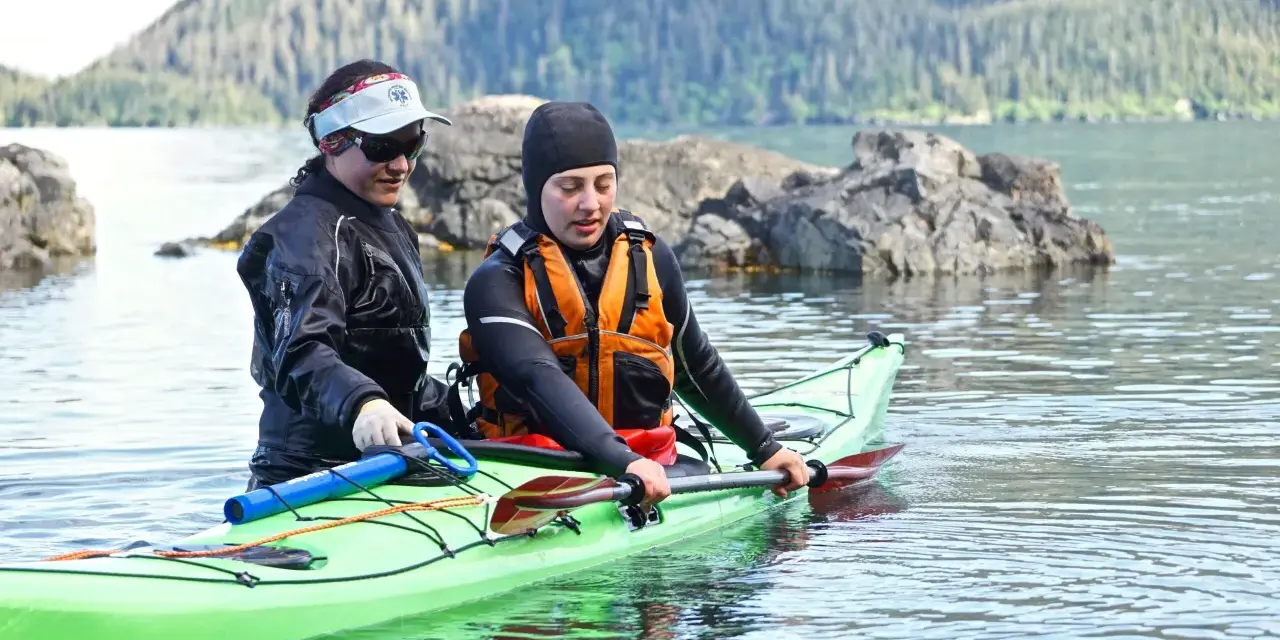
A reliable paddle-float re-entry is one of the most practical self-rescue skills for a touring or sea kayak, especially when you paddle alone or in a small group. It gives you a stable enough platform to climb back in, drain the cockpit, and keep the trip moving without turning a capsize into a full-blown emergency. In this guide I break down the setup, the sequence, the mistakes that usually break the rescue, and how the technique changes in UK water conditions.
Key points to know before you practise this rescue
- It works best in sheltered water, not surf, fast current, or steep wind chop.
- You need a well-fitted buoyancy aid, a spray deck, a bilge pump, and a paddle float within reach.
- Keeping the kayak close, low, and controlled matters more than strength.
- The rescue only becomes dependable after repeated practice in your own boat.
- Cold UK water makes speed and clothing choices matter from the first minute.
What a paddle float rescue is and when I would use it
A paddle float turns one blade of your paddle into an outrigger, which gives the kayak enough stability for a solo re-entry. The American Canoe Association treats it as a standard self-rescue alongside the scramble and re-enter-and-roll, and that is the right way to think about it, as one useful tool rather than a universal answer.
I reach for it when I am in a sit-inside touring or sea kayak, I can still stay connected to the boat, and the water is calm enough for a deliberate recovery. If the boat is drifting into wind, the sea is lumpy, or I am already exhausted, I would rather switch plans than force a rescue that is likely to fail. That decision depends on the conditions, which is why it helps to compare the technique against the rest of your rescue options.
| Situation | Good fit | Why |
|---|---|---|
| Sheltered lake or loch | Yes | Low chop lets the outrigger do its job and keeps the boat predictable. |
| Solo day paddle | Yes, if practised | Gives you independence when there is no rescuer nearby. |
| Wind against tide or breaking waves | Poor fit | Boat and body get pushed around faster than the rescue can settle. |
| Fast current or tidal race | Usually no | You may need a different self-rescue or outside help instead. |
That means the rescue is best viewed as a controlled backup, not a default reaction, and the gear setup is what makes it usable when things go wrong.
How to set up the boat and gear before you need it
The rescue only works if the right items are easy to reach while you are wet, cold, and trying to stay with the kayak. I like to keep everything on deck or on my person, never buried in a hatch where I would have to unpack the boat mid-rescue.
| Item | Why it matters | What I check |
|---|---|---|
| Paddle float | Creates the outrigger | Snug fit on the blade, secure strap, fast inflation, and ideally two chambers for backup. |
| Bilge pump | Removes water after re-entry | It is clipped on or otherwise reachable with either hand. |
| Buoyancy aid | Keeps you afloat if you slip back off the deck | It fits properly and does not ride up under load. |
| Spray deck | Limits flooding during normal paddling and recovery | It releases cleanly and can be refitted without a fight. |
| Means of communication | Useful if the rescue fails or conditions worsen | Phone or radio is on you, not floating somewhere in a dry bag. |
I also want the float secured where waves, wind, or an awkward capsize cannot wash it away. A rescue kit that is technically on the boat but not reachable in seconds is not a rescue kit, it is decoration. Once the gear is right, the actual sequence becomes much easier to learn.
The re-entry sequence I would practise first
This is the part that should feel boring after enough repetition. The calmest version of the rescue is usually the safest one.
- Stay with the kayak and right it quickly. The faster you flip the boat upright after the wet exit, the less water you usually have to handle later.
- Attach the float and inflate it. Slide the blade into the float, secure it properly, and inflate the chamber or chambers according to your model.
- Lay the paddle across the rear deck to form the outrigger. Keep the shaft steady and make sure the paddle cannot slide away while you are climbing back in.
- Get your torso onto the rear deck first. I think of this as horizontal first, seated later. If you sit up too early, the whole system becomes twitchy.
- Swing one leg and then the other into the cockpit. Move slowly enough that the kayak can settle under your weight instead of rocking from side to side.
- Stabilise, pump, and reset. Once you are seated, brace, drain enough water to make the kayak paddleable again, and only then sort the spray deck and paddling position.
The body position matters more than brute force. Keep your chest low, your weight toward the float side, and your movements compact. That is what turns the outrigger from a gimmick into a real recovery tool, and it is also where most people make avoidable mistakes.
The mistakes that make the rescue fail
The most common failures are not dramatic. They are small errors that stack up when you are tired, wet, and under pressure.
- Storing the float too far away. If you have to dig through a hatch, the rescue is already getting worse.
- Not practising inflation and attachment. Fumbling with straps and valves in cold water is slow, and cold hands make it slower.
- Trying to climb in while sitting high. A high centre of gravity makes the kayak roll as soon as you commit weight to it.
- Letting the paddle drift or twist. If the outrigger shifts, the boat becomes unstable in one second, not ten.
- Ignoring the amount of water left in the cockpit. A swamped kayak feels very different from a merely damp one, and it changes how quickly you can move.
- Practising only in perfect conditions. A rescue that works on a warm, flat evening may fall apart when wind and chop add even a little movement.
I also see paddlers underestimate how quickly they lose dexterity. The RNLI points out that cold-water shock can hit in water at 15°C or below, with the worst effects lasting several minutes, so the first part of the rescue is not just technical, it is physiological. That is why the next section matters just as much as the hand movements.
How UK conditions change the decision
British paddling changes the equation because the water is often colder than the air, and the sea, even on a decent-looking day, can turn awkward surprisingly fast. In that environment I dress for the water temperature, not the sunshine, and I treat a buoyancy aid as part of the rescue system, not an optional extra.
If I am on a sheltered loch, inland lake, or quiet estuary, a paddle-float re-entry is a sensible self-rescue to practise and rely on. If I am near surf, tide race, or a windy headland, I want a stronger plan, because the rescue window is smaller and the penalty for a mistake is bigger. I also want someone ashore who knows my plan, a charged phone in a waterproof pouch on my body, and enough margin in the forecast that I am not improvising in deteriorating conditions.
That is the practical UK version of the problem: conditions can stay benign for an hour and then stop being benign very quickly. Once you accept that, the next step is to train the skill until your hands know what to do before your head has fully caught up.
How to practise until the movement feels automatic
There is no shortcut here. I would rather see a paddler repeat a clean rescue a dozen times in quiet water than attempt it once in rougher conditions and hope for the best.
- Start in shallow, calm water. Learn the sequence where you can stand up or recover easily if something goes wrong.
- Practise on both sides. Real capsizes do not care about your dominant hand.
- Time the setup, not just the climb back in. The most fragile part is often the minutes spent attaching the float and stabilising the paddle.
- Use the same clothing and kit you actually paddle with. A rescue that only works in a lightweight demo setup is not enough.
- Add a little wind and light chop only after the flat-water version is clean. That keeps the challenge realistic without making the drill pointless.
If the whole sequence still feels rushed after several rounds, I would not move on to harder conditions yet. That is the moment to adjust body position, kit placement, or even the boat fit, because the boat should be helping you, not fighting you.
When another rescue is a better choice
I do not rank rescues by elegance. I rank them by what will work right now in the water I am actually in.
| Technique | Best use | Main limitation |
|---|---|---|
| Paddle float rescue | Solo re-entry in calm to moderate water | Slower, needs kit, and depends on a stable setup. |
| Re-enter and roll | If you have a dependable roll | Requires strong rolling skill and composure under pressure. |
| Scramble or heel hook | Low-volume boats and calm water | Can be awkward or unstable in a tippy touring kayak. |
| Assisted T-rescue or side-by-side | When another paddler is close by | Depends on partner availability and good teamwork. |
If I am paddling with others, I want everyone to know at least one assisted rescue as well as a solo option. In real group paddling, the best rescue is often the one that gets the swimmer back into control fastest, not the one that looks most polished in a pool session.
The small habits that make the rescue work on a British day paddle
The rescue itself is only half the story. The other half is the quiet preparation that makes it usable when the day stops being tidy.
- Keep the float and pump where you can reach them without opening a hatch.
- Carry your phone or radio on your body, not buried in the boat.
- Check wind, tide, and exit points before you launch.
- Tell someone where you are going and when you expect to be back.
- Practise with the kayak loaded the way you actually paddle, not stripped bare on a beach.
That is the version I trust: a simple rescue, a reachable kit, and a paddler who has already rehearsed the awkward part before the awkward part arrives. If you build the habit now, the paddle-float re-entry stops being a theory and becomes a calm, repeatable way to recover and keep going.
